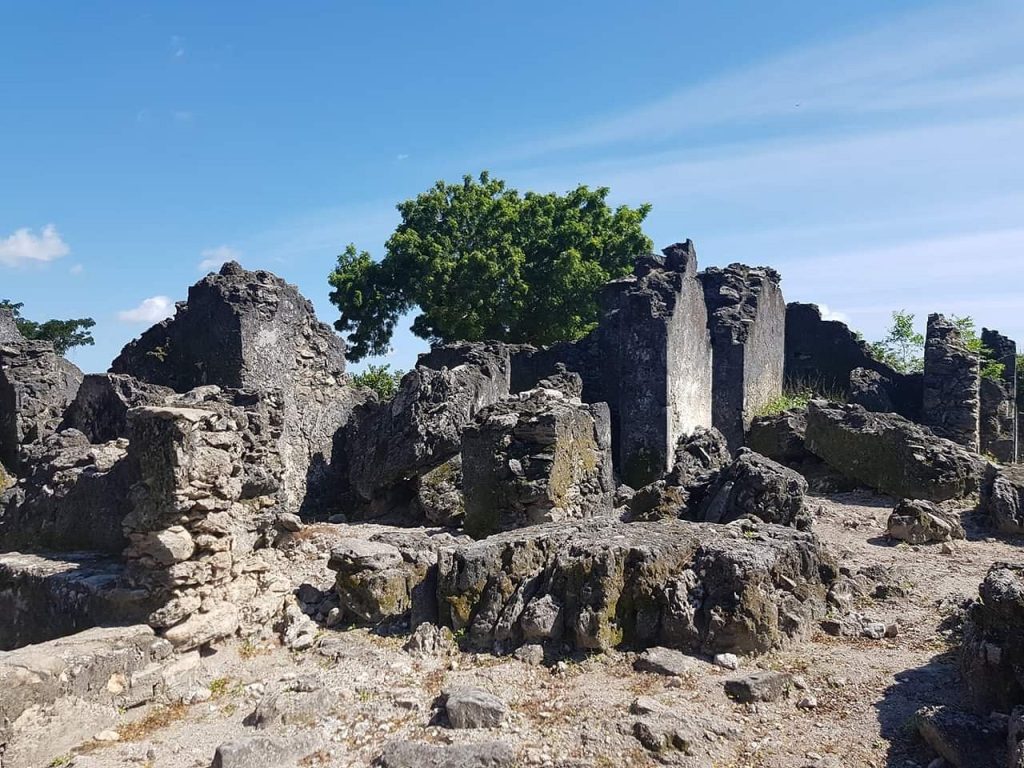
Bagamoyo : During most of history, Bagamoyo has been far more important than Dar, but in the last century, it has become a set of decaying ruins. The town was originally the mainland terminus for the slave routes that led from Lake Tanganyika before it became the capital of German East Africa. In Swahili, Bagamoyo means ‘lay down your heart’. It was here that those slaves who survived the three to six months walk from the interior, usually carrying ivory, eventually gave up all hope of freedom and of returning to their people. Over one million slaves in total were processed through Bagamoyo to the slave markets of Zanzibar. At the height of the trade, perhaps up to 50,000 slaves passed through in a single year. Once sold, they might end up anywhere in the Indian Ocean – India, Arabia or in the clove plantations of Zanzibar and Pemba.
What to See
Bagamoyo is a vast collection of deteriorating ruins, which desperately need the restoration that has now begun in some parts of Zanzibar’s Stone Town. Perhaps there is an attitude that questions the preservation of the material evidence of such an awful trade. Most sites are close to the waterfront, and there are official guides from Shizi Safari who will show you around them. The sites include the Arabic Tea House, the Customs House, the German Boma and the Old German Fort, built in 1897. One amusing exhibit is the doorway at the Anglican church, with the sign “Through this door, David Livingstone passed’, with the explanation that the door frame had been transported hundreds of kilometres from its original site on Lake Tanganyika, to its present location. Slavery eventually ended officially in 1873, although it continued illegally for many more years.
Much of the credit must go to the Holy Ghost Fathers, who, from 1868 began buying slaves, mainly children, in order to give them their freedom. They housed them in what they called Freedom Village at the north end of the town, and by 1872 there were over 300 freed slaves. Today at the site of Freedom Village there is a church, started in 1872, and also a museum that catalogues the story of the mission and its fight to have slavery outlawed. Open: 10am-5pm. Souvenirs for tourists in Bagamoyo are relatively low-key. However, there is one site that is definitely worth supporting.
Near the end of the tarmac, just off the road, is a project designed to help women craft-workers and entrepreneurs, called Bagamoyo Living Art and Handicraft Design Centre. Established in 1966, it trains women to increase their own commercial viability by helping them develop a variety of skills. Their work includes pottery, textiles and basketry. One can watch the women at work, and there is a small display area with goods for sale.