This is a well-known Tanzanian park: Serengeti means “dry and extensive land” in the Massai language. Yes, no doubt, it is one of the largest and most sumptuous parks in Africa. Great as eight times the neighbouring reserve of Maasai Mara in Kenya, smaller than the Selous Reserve (southern Tanzania), but larger than Lebanon. Serengeti (14,763 km2) is half the size of Brittany. It represents the African Nature with a great N. This is what is called an authentic sanctuary (although sanctuary is a macabre word) of wildlife, one of the last natural paradises of the planet.
There are thousands of animals of every species, of all sizes in Serengeti National park, they are living there, growing up, evolving freely, in landscapes worthy of the first day of creation. This is to remind you about the origins of the world, the ark of Noah, and Genesis.
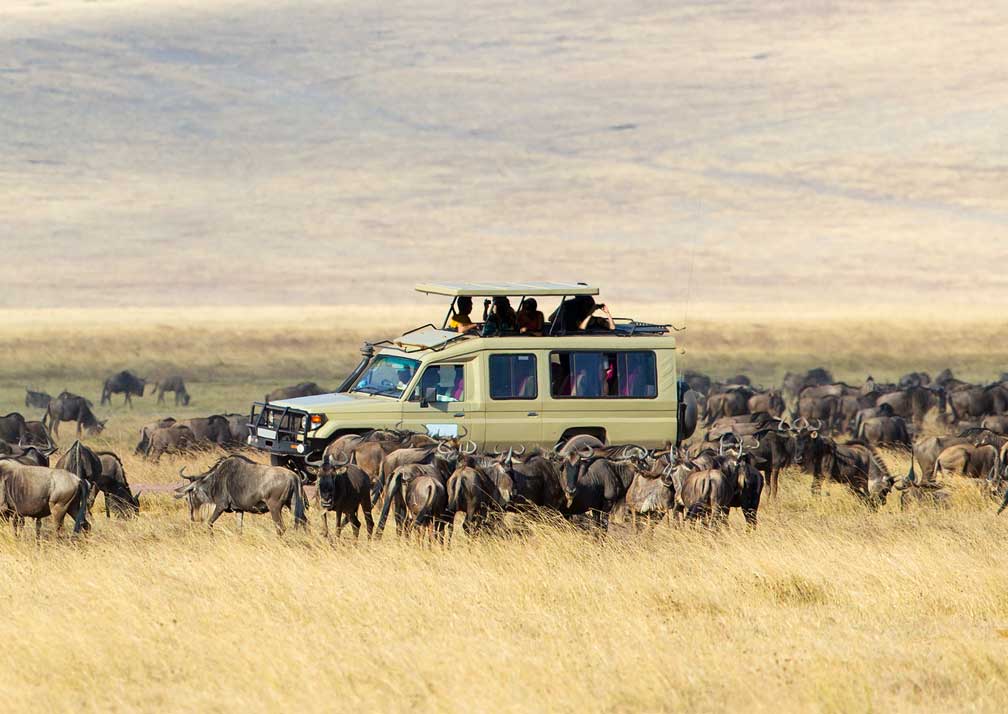
Wildlife in Serengeti National Park
Serengeti National park is the Kingdom of Animals! Here, Animals, you will see them, you will feel them, you will admire them, so true, so pure, in their innocent innocence. Do not disturb them. They will return your own image, alternating, both animal and human. From La Fontaine to Walt Disney, childish stuffed toys to the signs of the horoscope, animals have always been an inexhaustible source of inspiration. And you will learn a lot from them. Is it their genius? Still, this piece of Tanzania is the best lesson of observation and wisdom. The Serengeti is an immense bestiary written in the book of the weeds of Africa.
After careful observation of the animal kingdom (Serengeti National park), you will find out that an invisible connecting thread always brings us back to the life of human beings, the great principles that governed us (and still govern us) before the irruption of consciousness in the brain of Homo Habilis, our ancestor. The sense of territory, the desire for freedom, the instinct for survival, family spirit, sedentary and nomadic life, solidarity against the enemy, the protection of children and the clan, these are some characteristics of animal life that you can find in this endless plains of Serengeti.
Like humans, these wild beasts also spend some of their time spying, watching, and devouring each other. Never by malice, or pleasure to do evil, simply by the instinct of life and survival. No angelism here, no romanticism, but the rawest, the most authentic realism, present before your eyes at any time of day and night during your game drive. So everyone has to decipher the enigma of Serengeti and the secret march of this wild world. The law of the bush does not change, it remains the pitiless one of the jungle: the strongest is often right on the weaker. The reign of animals is called harmony as well as injustice, inequality, violence, even cruelty. If the traveller seeks a lesson, it is undoubtedly that one.
Let them live among themselves, with or without men. Better: under the protection and with the complicity of the men. Wilderness has its own rules, its share of light and darkness, wonderful and terrible. And that is why she is nature. To understand the Serengeti (and the wildlife), it is important not to apply the laws of Good and Evil to the animals without thinking, leaving these universal human values simply at the entrance to the park. In this “wilderness” everything is to be observed, everything is to be bitterly meditated. Scratch the Man, you will find the Beast, scratch the Beast you will find the Man! Joseph Conrad said that the sea was the mirror of the human soul. And if the African bush was the most faithful mirror of the animal soul?
How to get there?
Most safaris leave from Arusha. They pass Lake Manyara or Tarangire National Park (1 night), Ngorongoro (1 or 2 nights), then the Olduvai Gorge, before crossing the Serengeti National Park (2 nights or more). If you have not already organized everything from your country (like 95% of travellers, via a travel agency), you can still organize your safari by contacting one of our safari expert at Safari ASAP. We always corresponding to your budget and your needs. We must compare the benefits and prices, and not rush. To help you choose the right agency, refer to our article on how to choose the best Safari Company in Tanzania.
When to go?
– Dry season: It lasts from June to November.
– Rains Season: At the season a small of the rains (Vuli): the provoked Serenqeti by knows the monsoon in principle of the southwest, two seasons in avrildes
and May. And a large (masika), which arrives with the northeast monsoon from November. Nothing is ever certain, nor systematic, in the field of climates, it happens that the dry season is prolonged more than usual or that it is not interspersed with a few storms. Example: in February, the weather is nice and warm every day. Sometimes a few small ones
How to move inside the park?
The least bad solution is to board a vehicle to land, 4 or 5 people. What 99% of visitors do, of course. 6 people in a 4 x 4, the rental price per head are lower but you can start feeling crowded.
In addition to spending a few Tanzanian shillings, choose a real 4×4, a four-wheel drive, like Land Rover or Land Cruiser.
Even if it has become the norm (because cheaper), avoid as much as possible the false-real 4×4 Japanese vans too low on wheels: they do not go everywhere and hold pretty badly the track (risk of accident).
Serengeti in the rain Season
Nothing is more beautiful than the rain! If decried in Europe, it is not a gift from heaven for Africa? And are not the anthracite grey clouds, laden with water like divine sponges, signs for men of hope and renewal? Rain is Life. Even if the muddy trails become a little less comfortable to practice at this time, the rainy season is for a traveller one of the most beautiful experiences of observation of the wild world.
The rain never comes without warning. Thick, dark clouds are piling up in the sky, driven by a wind from the distant Indian Ocean. The first drops of a water fall on the dry earth and on the dust. By dint of drying out, the ground has formed a shell hardened by the sun which it seems incapable of absorbing this beneficent water. At that moment, it looks like the earth has lost everything, including the taste of water. But the strength of the elements is such that the soil of the Serengeti will not be able to resist it for a long time. He begins to engulf himself. Finally! Nature exhales perfumes of earth and wet grass. A wonder for the senses. The arrival of the rain is a blessing for this “arid and uncluttered land” (meaning in the Masai language of the word Serengeti), a relief for animals, and a gift of the gods for men. Thunderstorms and moisture guarantee each year a new grass and water points to the animals.
“Good pasture means good milk and so beautiful little ones. This could be a suitable saying for this arid savannah. Satisfied, freed from the sufferings of the drought, the lions welcome the rain with roars of joy. Roarrr! Thanks to this nourishing water, the cubs will be able to survive. Cheetah cubs born at the end of the dry season will not be sacrificed by the unfairness of the weather. For them, rain is synonymous with plenty: at least they will not die of starvation or thirst. Females will easily find something to feed them: hares, birds, gazelles. Giraffes will find it easier to drink in pools with the highest water level. The herbs change color. The landscapes are green again. Another wonder of nature in the rain: migratory birds. Coming from Europe, they make a stop at Serengeti. Thousands of storks plummet on the plains, buzzards twirl in the sky, plovers from Asia fly in tight formation. Swallows, swifts, terns stalk insects, which swarm in the rainy season.
When the short rainy season comes to an end, by the end of May wildebeest have already begun their large migration (see details later) from the south-east of Serengeti to the western corridor (Western Corridor). Thus nature transforms itself, overnight, as if a divine hand decided to save the world, at the last minute, at the worst moment of its distress.