Nairobi City
Mark Knopfler could almost have been singing about Nairobi when he wrote Telegraph Road. Until the late 1800s there was nothing there. It was just a watering hole for the Maasai. Then came the Mombasa to Uganda railway, with its 32,000 indentured Indian labourers from Gujarat and the Punjab, along with their British colonial overlords intent on beating the German colonial push for the Ugandan heartland. Being approximately halfway between Mombasa and Uganda and a convenient place to pause before the arduous climb into the highlands, it quickly became tent city.
Much of the area was still a foul-smelling swamp at this time and game roamed freely over the surrounding plains, yet by 1900 it had become a town of substantial buildings and five years later succeeded Mombasa as the capital of the British East Africa protectorate. Since then it has gone from strength to strength and is now the largest city between Cairo and Johannesburg. The tower blocks of Nairobi can be seen for miles as you crest the hills which surround the plain on which it sits. Yet, in terms of the world’s largest cities, Nairobi is still small with a population of about one million.
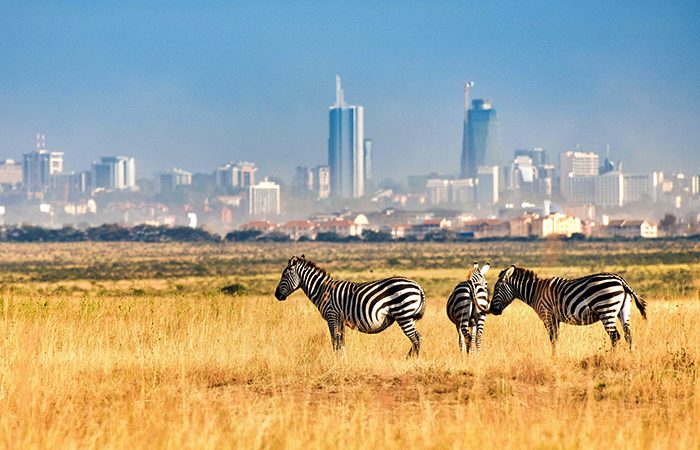
You can walk from one end of the central business district to the other in 20 minutes. And where else in the world would you be able to see lions, cheetahs, rhinos and giraffes roaming free with the tower blocks of a city as a backdrop?
It’s a very cosmopolitan place lively, interesting, pleasantly landscaped and a good place to get essential business and bureaucratic matters sewn up. This is no Third World capital city though there are some very overcrowded slums on the outskirts and even across the other side of the Nairobi River from Kirinyaga Rd. The latter are periodically bulldozed away and burnt down by the city council in the interests of hygiene but it takes only days for them to regenerate!
Like most cities, Nairobi has its crowded market and trading areas, its middle class/office workers’ suburbs and its spacious mansions and flower-decked gardens for the rich and powerful. The first is an area full of energy, aspiration and opportunism where manual workers, exhausted matatu drivers, the unemployed, the devious, the down-and-out and the disoriented mingle with budget travellers, whores, shopkeepers, high school students, food-stall vendors, drowsy security guards and those with life’s little illicit goodies for sale. It’s called River Rd — though, of course, it spans more than just this road itself. One of the funniest yet most poignant yarns I have ever read about an area such as this is to be found in a novel by Kenyan author Meja Mwangi called Going Down River Road (Heinemann, African Writers Series). I’d recommend this book to anyone and especially travellers passing through Nairobi. Even if you are not staying in this area you should make a point of getting down there one day just to see how the other half lives on the wrong side of Tom Mboya St.
Elsewhere in Nairobi are all the things you won’t have seen for months if you’ve been hacking your way across the Central African Republic and Zaire from West Africa or making do with the shortages in Zambia and Tanzania. Things like the latest films on big screens, bookshops, restaurants, cafés and bars full of travellers from all over the world, offices where you can get things done with the minimum of fuss, banks where you can change travellers’ cheques in less than five minutes and a poste restante where you sort out your own letters from the pile so you don’t end up with that feeling that letters have been put in the wrong pigeonhole. It’s a great place to stay for a week or so but if you stay too long it can get expensive because almost everyone you meet wants to do the same as you did when you first arrived plurge at the restaurants and drink their fill in the bars and rage in the discos.
Nairobi National Park
This park is the most accessible of all Kenya’s game parks, being only a few km from the city centre. You should set aside a morning or an afternoon to see it. As in all the game parks, you must visit it in a vehicle; walking is prohibited. This means you will either have to a lift at the entrance gate with other tourists, go on a tour, or hire a car.
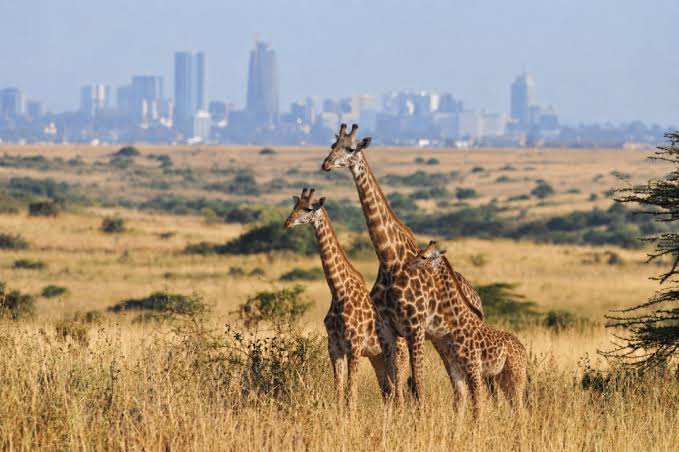
Nairobi National Park is the oldest park in the country, having been created in 1946. For a park so close to the city centre you can see an amazing variety of animals — with a backdrop of jumbo jets coming in to land at Jomo Kenyatta International Airport which is adjacent to the park! Gazelle, Oryx, lions, zebras, giraffes, buffaloes, cheetahs and leopards are all seen regularly. Elephants are not found in this park as the habitat is unsuitable.
The concentrations of game are higher in the dry season when water sources outside the park have dried up. Water is more plentiful inside the park as small dams have been built on the Mbagathi River which forms the southern boundary of the park.
The Animal Orphanage by the main gate has a sign inside the gate which reads ‘this is not a zoo’ — it is. From time to time there are young abandoned animals which are nursed, treated and through to good health and then released, but basically, it is just a zoo.
The Bomas Of Kenya
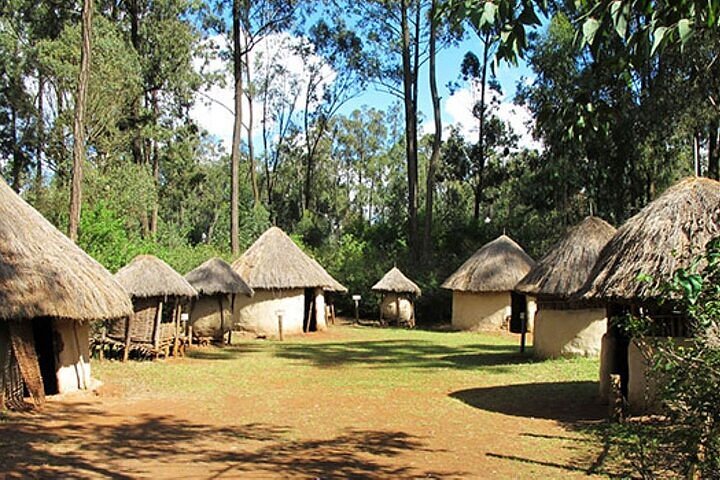
The Bomas of Kenya is a cultural centre at Langata — a short way past the entrance to the national park on the right-hand side as you head south-west from Nairobi. Here you can see traditional dances and hear songs from the country’s 16 ethnic groups amid authentically recreated surroundings, though the dances are all done by one group of professionals rather than representatives of the tribes themselves. There is a daily performance. There’s the usual clutter of souvenir shops around the site. If you are not on a tour, matatu from outside Development House, Moi Ave, will get you there in about half an hour.
Karen Blixen Museum
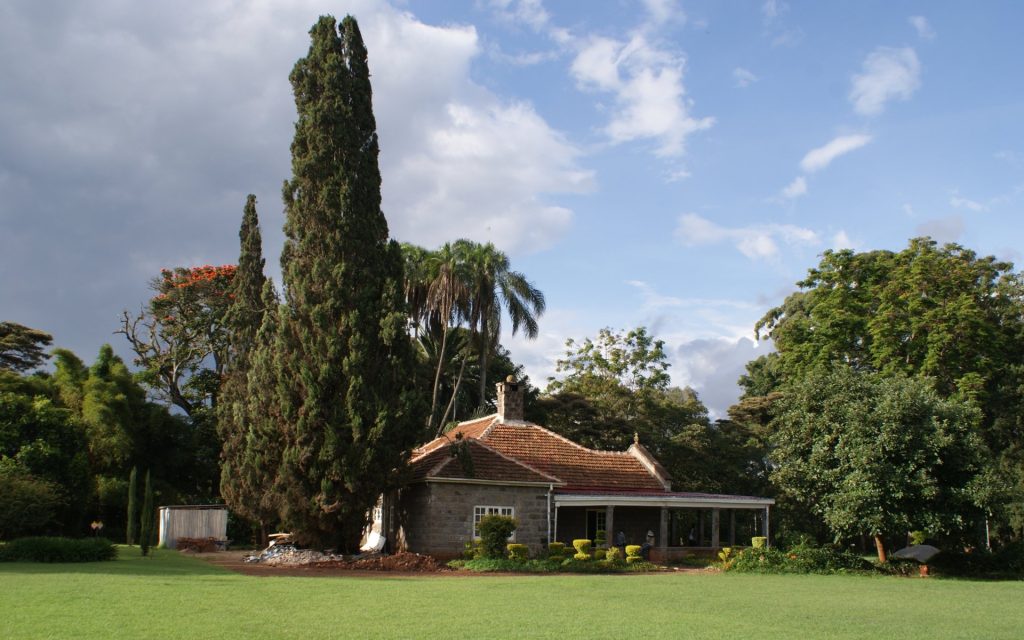
This is the farmhouse which was formerly the residence of Karen Blixen, author of Out of Africa, and was presented to the Kenyan government at independence by the Danish government along with the adjacent agricultural college. It’s open daily from 9.30 am to 6 pm. It’s right next door to the Karen College on Karen Rd about one km past the Karen Club as you come from Nairobi along Ngong Rd.
Getting There & Away
A No 24 matatu from Mfangano St near Hakati St will get you there in about 40 minutes at a cost of Ksh 70 to Ksh 150. Alternatively, take public bus No 27 from Kenyatta Ave or from the corner of Ralph Bunche and Ngong Rds to Karen village (the shopping centre) and change to a No 24 matatu there.
Langata Giraffe Centre
The Langata Giraffe Centre is on Gogo Falls Rd about one km from the Hardy Estate shopping centre in Langata, about 18 km from central Nairobi. Here you can observe and hand-feed Rothschild giraffes from a raised circular wooden structure, which also houses a display of information about giraffes. It’s open during school terms from 9.30 am to 5.30 pm daily, with admission costing for non resident KSh 1,500 (approx. $15.00) (non citizen children KSh 750 (approx. $7.50). To get there from the centre, take a matatu to the shopping centre in Langata and walk from there, and don’t forget your valid identity card.
Ngong Hills
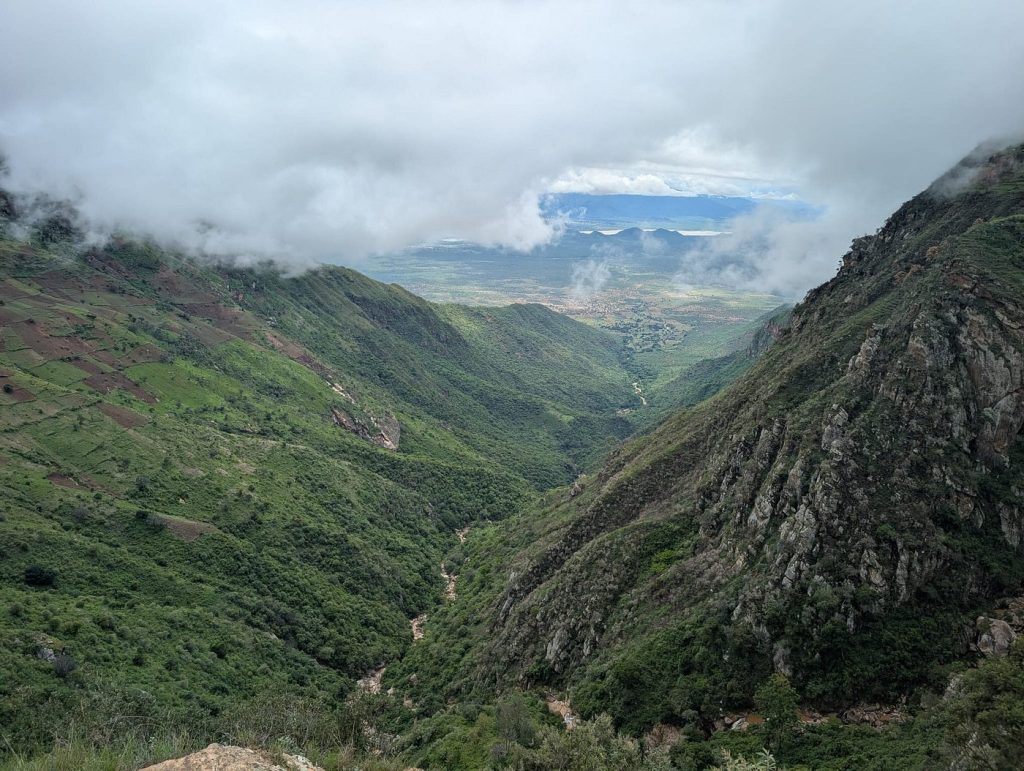
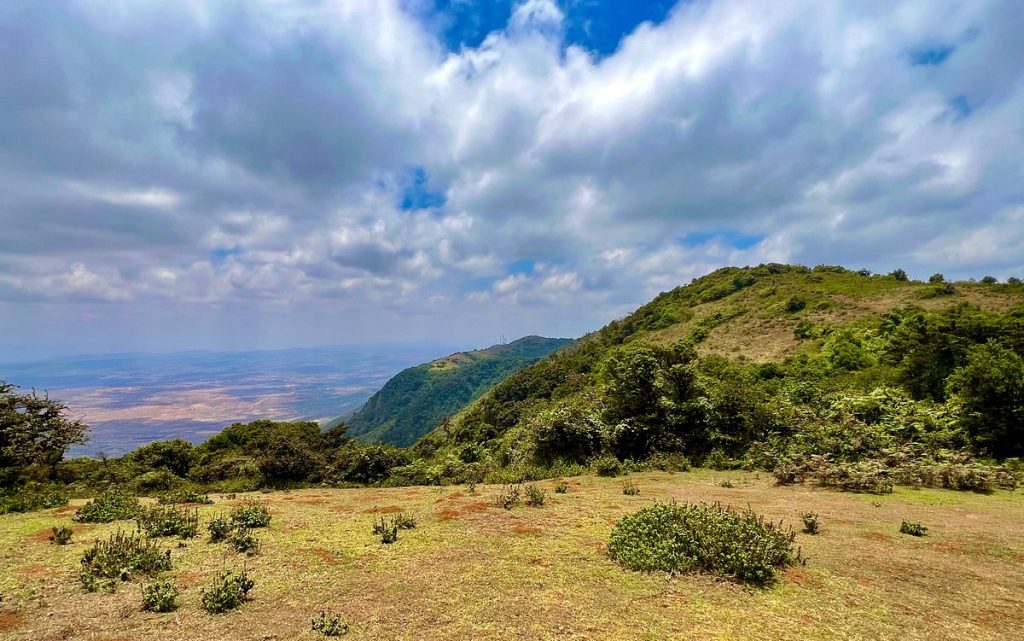
Ngong and Karen, to the west of Nairobi, along with Limuru, to the north, were the sites where many White settlers set up farms and built their houses in the early colonial days. The transformation they wrought was quite remarkable so that, even today, as you catch a glimpse of a half-timbered house through woodland or landscaped gardens full of flowering trees, you could imagine yourself to be in the Home Counties of England or some other European location. And, yes, the eucalypts which you see growing everywhere were an Australian import. There are some excellent views over Nairobi and down into the Rift Valley from various points in the Ngong Hills.
Orientation
The compact city centre is in the area bounded by Uhuru Highway, Haile Selassie Ave, Tom Mboya St and University Way. The main bus and train stations are within a few minutes’ walk of this area, while the main budget travellers’ accommodation area is centred around Latema Rd, just east of Tom Mboya St on the fringe of the bustling and somewhat sleazy River Rd area.
To the west of the centre is one of the more enlightened bits of Nairobi town planning — Uhuru Park. It’s a much needed lung for this increasingly crowded city and is a pleasant place in the daytime. At night it becomes a mugger’s paradise and should be avoided.
Directly west of Uhuru Park, and still within walking distance of the centre (but don’t walk at night!), are some of the city’s better middle and top-range hotels, the popular youth hostel, a number of government ministries and the hospitals. Beyond here are the sprawling upper middle class suburbs of Ngong and Hurlingham with their large detached houses and carefully tended gardens surrounded by high fences, and guarded by askaris (police) along with prominent signs warning that the premises are patrolled by ‘Ultimate Security’, ‘Total Security’, ‘Securicor’ and the like. These signs are surely one of the most enduring Impressions of suburban Nairobi!
North of the centre is the university, the national museum, the International Casino and one of Nairobi’s original colonial hotels, the Norfolk. Beyond here is Westlands, another of Nairobi’s upper middle-class suburbs. North-east of the centre is Parklands, which is home to many of Nairobi’s Asian minority and where the Aga Khan Hospital is to be found. Close to the hospital is the popular Mrs Roche’s guesthouse. Going east, there are the bustling and predominantly African suburbs of Eastleigh and Pangani along with the country bus station. South of the city is Nairobi National Park,