
Table of Contents
Introducing The “Big Five”
When you start researching an African safari, the term “Big Five” often crops up. The “Big 5” refers to the African lion, leopard, rhino, elephant, and Cape buffalo. Why not the hippo, gorilla, or giraffe, you may ask? Are they not large as well? How about the cheetah — that would be an animal you would probably like to see as much as a buffalo. Well, the term “big five” was actually coined by big game hunters (not safari tour operators).
It refers to the difficulty in bagging these large animals, mostly due to their ferocity when cornered and shot at.
Safari tour operators took the phrase “Big Five” and turned it into a marketing term. A shame, really, since many guides can speed past a giraffe en route to buffalo simply because it was assumed clients would want to see the “big five” over anything else. A poll I conducted shows that I am not alone in finding a giraffe infinitely more exciting to spot than a Cape buffalo.
What About the “Little Five”?
The “Little Five” is just a fun idea, not based on anything beyond the fact that there are five little animals found in Africa, with names corresponding to the “Big Five”.
The Little Five are: the Rhinoceros Beetle, the Buffalo Weaver, Elephant Shrew, Leopard Tortoise, and the Ant Lion.

What’s the “Big Seven”?
You may also come across the term “big seven”, South African Tour operators coined this phrase; it’s just another clever safari marketing term. Nevertheless, it proves that South Africa has an incredible diversity of wildlife, as the “Big 7” also includes the Great White shark and the Southern Right Whale.
African Elephant (Loxodonta africana)
The African elephant (Loxodonta africana) is the largest mammal in the world and remarkably adaptable. Elephants live in woodlands, forests, deserts, and savannas, spread across 37 countries in sub-Saharan Africa. The demand for ivory led to a dramatic decrease in elephant numbers, especially during the 1970’s and 1980’s. A ban on all ivory trade has helped stabilize the population to around 600,000 in the last decade.
Elephants are quite peaceful if left alone, but if they feel threatened – watch out. There’s nothing quite like being charged at by a 12,000 lb’s animal, flapping its ears and trumpeting loudly. Elephants can be over 14 feet tall and 30 feet wide. They drink 30-50 gallons of water every day and are vegetarians. They eat grass, leaves, twigs, bark, fruit and seed pods. Adult elephants consume up to 375 lbs of vegetation every day. This causes significant destruction if their habitat range is limited. You can easily tell where a family of elephants have been by the number of destroyed trees they leave in their wake.
Elephants are very social animals; they communicate using a variety of low frequency grumbles and rumbles which can be picked up 6 miles (10km) away. They live in family groups of up to 100 members, headed by a matriarch.
Elephants are social and affectionate animals. Elephant mothers are very attentive to their babies, and orphans are nursed by other mothers in the group. A young elephant is weaned at 4-5 years old, when their tusks start to get in the way, they may move out of the family group at 10-12 years old.

Fun Facts About The African Elephant
- An elephant’s trunk is the fusion of its upper lip and nose; it has more than 40,000 muscles.
- An elephant calf often sucks its trunk for comfort.
- Elephants prefer one tusk over the other, just as people are either left or right-handed.
- Elephants use their trunk as a snorkel when swimming.
- Elephants waive their trunks up in the air and from side to side to smell better.
- An elephants’ skin is an inch thick.
- Elephants flap their ears to keep cool.
- Elephants spend up to 16-18 hours per day eating.
- An adult Elephant can consume up to 375 lbs (170kg) of vegetation daily.
- Elephants’ tusks grow throughout their lives.
- Elephants use their feet to listen. They pick up sub-sonic rumblings made by other elephants through vibrations in the ground.
African Lion (Panthera leo)
The African lion (Panthera leo), king of the sub-Saharan savanna, has been admired by man for its beauty and strength for thousands of years. It’s one of the most exciting animals to see on safari. These beautiful, large cats are excellent hunters but you’re more likely to see one sleeping than hunting. Lions are very social animals; unlike other cats, they live in prides of several females, their young and a couple of males.
They will cooperate when hunting difficult prey like a buffalo, but usually they’ll take down an antelope on their own. Females hunt more than males and all lions will happily scavenge given half a chance. Lions ambush their prey (like leopards), rather than track and chase (like hyenas).
Lions can reach around 14 years of age, but many males die sooner because they get injured fighting one another. Female lions synchronize the birth of their cubs and cooperate in raising them. Females tend to stay with their pride for life, male cubs get kicked out when they are between 2-4 years old. Lions have few natural predators besides the occasional buffalo, but of course man is its biggest threat.
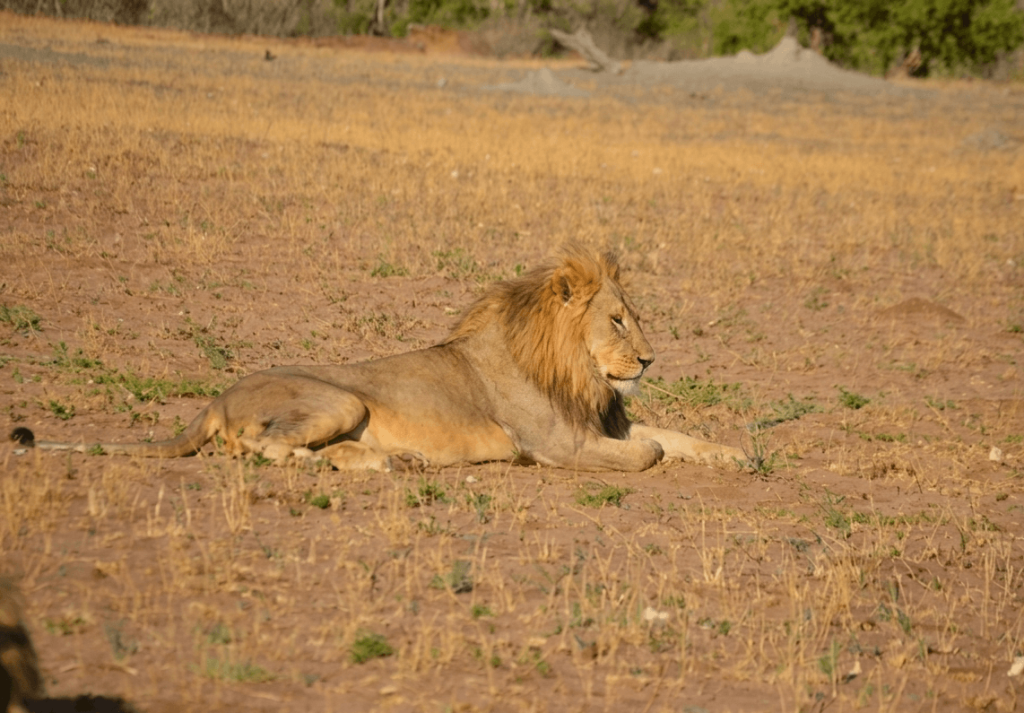
Fun Facts about the Lion
- Lions rest around 20 hours a day.
- Lion cubs are born with spots (rosettes).
- The size and coloration of a lion’s mane shows other males how fit and strong he is, the darker and larger the mane, the stronger the lion is.
- Lions do not purr like house cats.
- All lion tails end in a hairy tuft that develops when a cub is around 5 months old.
- Man-eating lions do exist.
- All lions can climb trees, some rest up high more than others in certain areas to avoid buffalo and tsetse flies (notably in Lake Manyara, Tanzania).
- Lions do not like to swim.
- As lion cubs get older, they nurse from any lactating female in their pride.
- Lions can discriminate the roars of large groups from those of small groups and those of strangers from companions.
- Male lions mark their territory by spraying a combination of urine and scent from glands at the base of their tails
African Leopard (Panthera pardus)
The African leopard (Panthera pardus) is more numerous than the African rhino in the Big 5 pantheon, but they are just as difficult to spot on safari in Africa. Leopards use trees as observation platforms and for protection, so you have to remember to look up to see this solitary, beautiful cat. Leopards are shy and nocturnal, quite modest for a cat that can climb, swim and live in a wider range of habitats than most other wild cats.
A leopard’s spots offer excellent camouflage as they move about their range, seldom staying in the same area for more than a few days. Males tend to have larger ranges than females and mark it by urinating and leaving claw marks. Leopards tend to store their fresh kill up in a tree to avoid it getting poached by lions and hyenas. Leopards are smaller than lions, but an adult male can still weigh in at 200 lbs. They can run at speeds of over 35 mph (56km/h), and are extremely agile jumpers.
Leopards live throughout sub-Saharan Africa. They cover a wide range of habitats from the thick forests of West Africa to the highlands of Ethiopia, but they prefer thick bush and riverine forests. Find out the best places to see leopards in Africa. A leopard’s only predator is man.
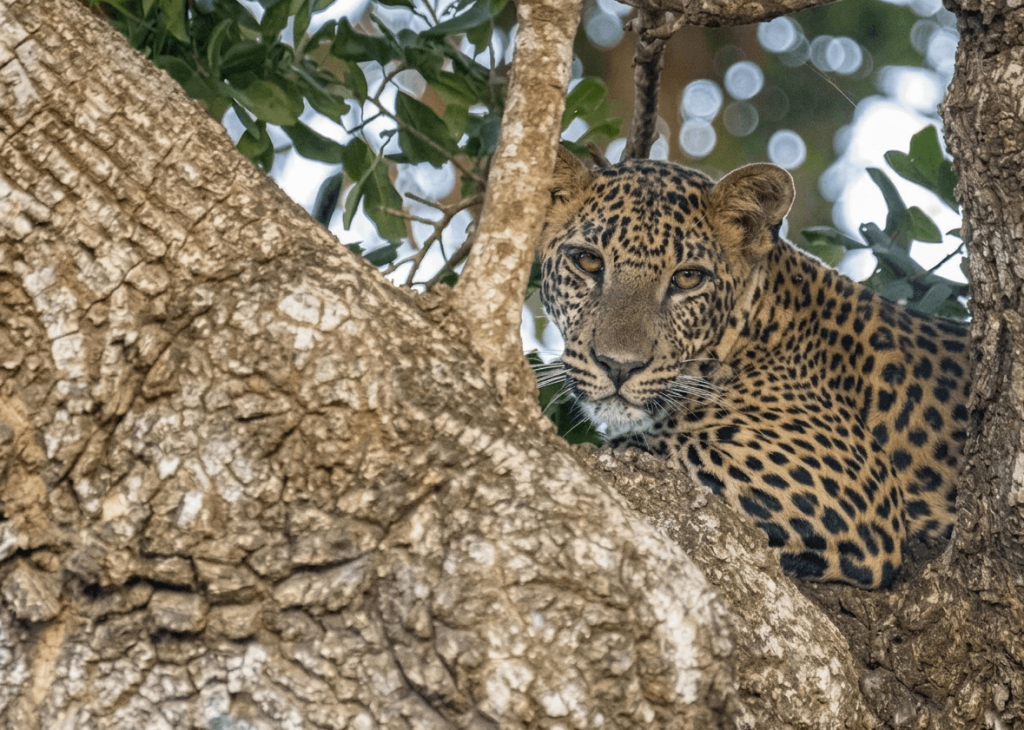
Fun Leopard Facts
- Leopards can kill prey larger than themselves
- Leopards purr
- Leopards are excellent swimmers
- A leopard’s spots are in fact irregular circles called “rosettes”
- A leopard stalks and pounces its prey, rather than chase it long distances
- A leopard with no spots and a black coat is called a panther
- A leopard cub begins to hunt with its mother at around 4-5 months old
- The leopards’ spots are circular in East African but square in southern Africa
- Leopards can jump 10 feet (3 m) straight up
- White spots on the tip of their tails and back of their ears help leopards locate and communicate with each other in tall grass
- The leopard is the most solitary and elusive member of the Big Five
African Rhino (Diceros bicornis & Ceratotherium simum)
There are two species of rhino in Africa, the Black rhino (Diceros bicornis) and the White rhino (Ceratotherium simum). Black rhinos have suffered the most drastic reduction in population in the last 20 years. There are now only about 4000 left in the wild although valiant conservation efforts are increasing those numbers. The white rhino is more numerous numbering at over 17,000 but they are heavily concentrated in Southern Africa.
Rhinos are actually neither black nor white in color, they are all grey.
Black rhinos are usually solitary, whereas white rhinos tend to be more social and live in groups. Black rhinos live in savanna, shrub and tropical bush areas, they eat leaves, bushes, small tree branches and shoots. White rhinos live in the savanna and are grazers. Their lips are what distinguish them from one another, a black rhino has a prehensile lip to strip leaves off bushes. A white rhino has a long, flat lip adapted for grazing.
Rhinos are large mammals (only second in size to the elephant), an adult white rhino can weigh in at 6,000 lb’s! Rhinos are indeed shortsighted, a little bad tempered, but magnificent to look at. Unfortunately there aren’t too many to look at these days due to poaching. Rhino horn, used for medicinal purposes to reduce fevers, is much prized in Asia. In 2012, rhino horns were valued at $30,000 per pound ($60,000 per kilo), with each horn weighing in at about 6-8 lbs, that’s a lot of temptation for poachers thus leading to a devastating poaching crisis.
If they manage to avoid poachers, rhinos can live up to 30-50 years.
Where to see the African Rhino?
Because of their endangered status, rhinos have been protected in several private reserves dotted around Southern Africa and black rhinos in particular are being re-introduced to national parks that are better protected these days like Ngorongoro Crater.
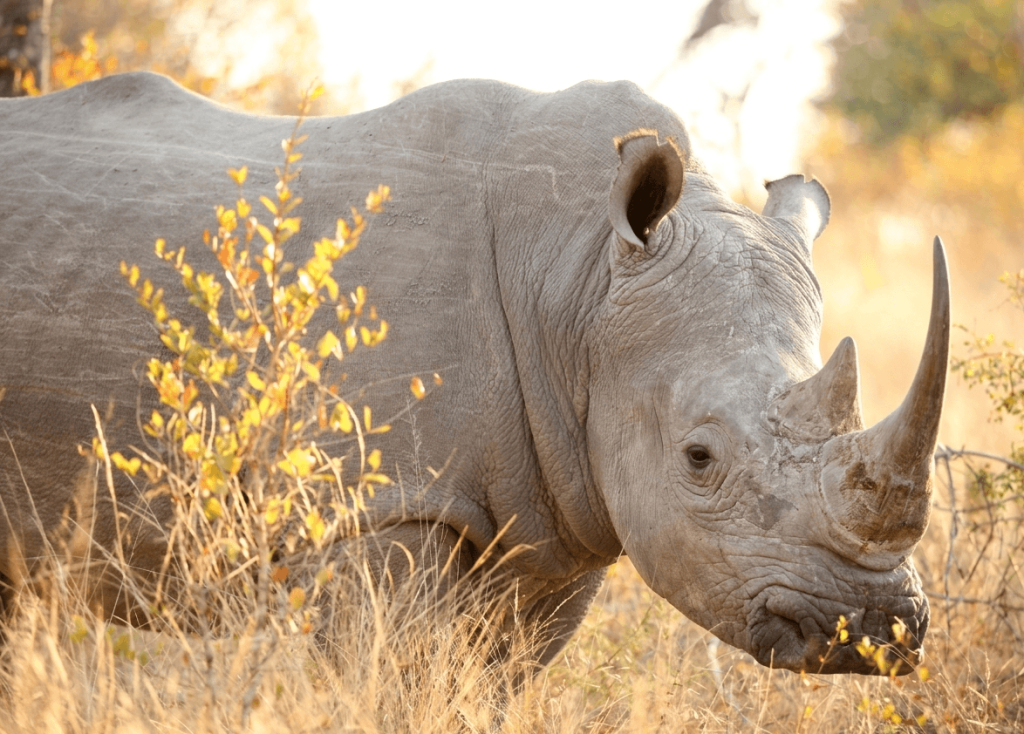
Fun African Rhino Facts
- South Africa is home to more than 80% of Africa’s rhino population.
- Neither is actually black or white; they are both shades of grey. The name “White” likely comes from the Dutch word weit (wide), referring to their muzzle.
- Rhinos have three toes on each foot
- A group of rhinos is called a crash
- Oxpeckers eat the ticks off a rhino’s hide and also warn of danger.
- A charging rhino can reach speeds of 35 mph.
- A rhino’s horn is made of keratin, the composite is similar to a horses hoof.
- Man is the rhino’s only natural predator.
- Rhino’s have roamed the earth for more than 50 million years.
- Female rhinos are pregnant for 15-16 months
Unpleasant Facts About the Rhino’s Current Status
- There are thought to be 29,000 rhinos left in the world, 20,000 of which live in South Africa.
- Over 1000 rhinos were poached in South Africa in 2013.
- Rhino horn has been used in traditional Chinese medicine for centuries, it is thought to cure a number of ailments from fevers to gout, and these days it’s rumored to help cure cancer.
- A pound of rhino horn is worth $30,000, a kilo is worth $65,000.
- The main markets for rhino horn include China, Vietnam and Thailand where the upcoming middle classes can afford to spend more on traditional medicine.
- Asia only has 3,000 rhino left (no surprise given the local demand).
- South African wildlife authorities have made over 200 arrests related to rhino poaching in 2012.
Cape Buffalo (Syncerus caffer)
Cape Buffalo are commonly found in protected wildlife areas (that have plenty of water), throughout sub-Saharan Africa. Four sub-species of African Buffalo have been recognized and basically reflect the different type of regions and habitats they live in: Forest Buffalo (S. c. nanus); West African Savanna Buffalo (S. c. brachyceros); Central African Savanna Buffalo (S. c. aequinoctialis); and Southern Savanna Buffalo (S. c. caffer). The forest buffalo are smaller than those found in the savanna.
Cape buffalo are large, adults stand 4-6 feet tall and males weigh in at around 700 kg’s (1500 lb’s). Even lions don’t dare take a chunk out of this beast unless they have friends helping them. Often underestimated by tourists, the Cape buffalo is considered one of Africa’s most dangerous animals. They have reportedly killed more big-game hunters than any other animal on the continent. Needless to say, the Cape buffalo has never been domesticated, but if left alone, they are quite placid, just like their bovine brethren.
On the more open grasslands, Cape buffalo appear in large herds that can number up to a thousand individuals. Remarkably, there are few scuffles between herd members; perhaps the large males with their strong curved horns realize they could seriously injure one another in a brawl. Males will fight for dominance, but the battles are brief.
Cape Buffalo need to drink every day, so they are often found close to water and never in the desert.
They prefer to eat tall, coarse grass as well as bushes. Cape buffalo numbers are shrinking because they are hunted for their meat, and they have also been the victims of various domestic cattle diseases. There are thought to be around 1 million Cape buffalo left in Africa.
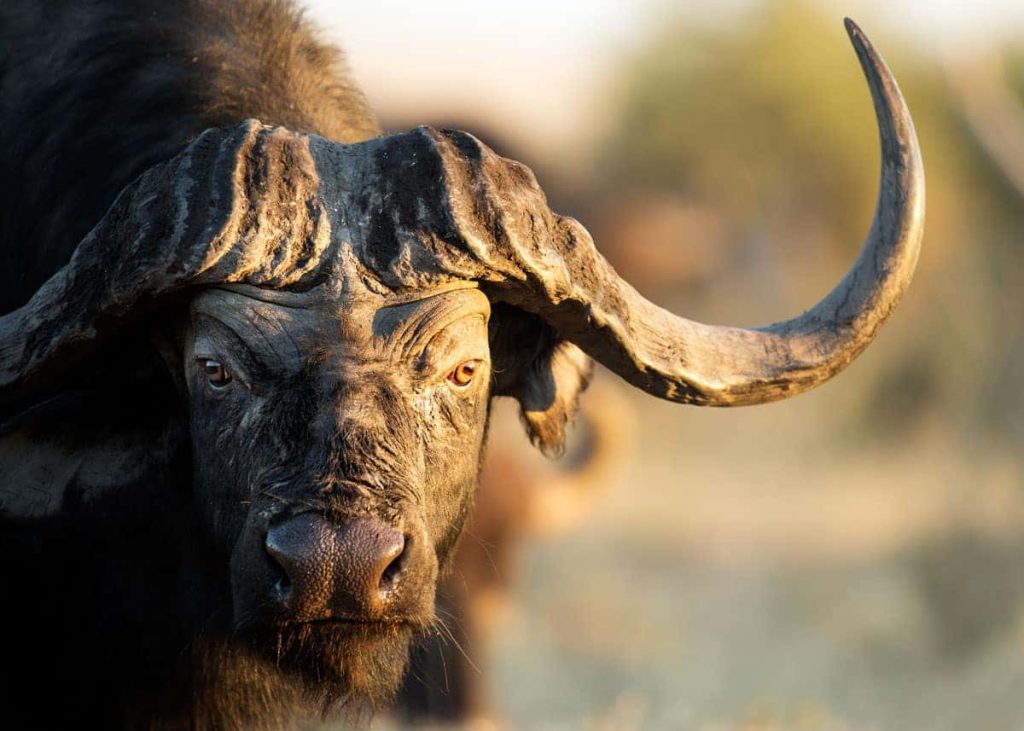
Fun Facts About the Cape Buffalo
- Buffalo will protect their calves by pushing them into the middle of the herd when danger lurks.
- Buffalo will mob a predator, especially if there’s a calf calling for help.
- Buffalo mate and give birth during the rainy season only.
- Cape Buffalo have never been domesticated.
- M’bogo is the (Ki)Swahili word for Cape Buffalo..
- The ox-pecker bird keeps the Cape Buffalo clean by eating all the parasites that live in its thick hide.
- The Cape Buffalo can run at speeds of 35 mph.
- Old males are known to be particularly grumpy and defensive, sometimes called “The “Dagga Boy”.
Frequently Asked Questions
What are the Big Five animals and why are they called that?
The Big Five are the lion, leopard, elephant, rhino, and buffalo. The name comes from old hunting days when these animals were considered the hardest and most dangerous to track on foot. Today, it’s more about spotting them on safari than hunting them. Each one has its own personality and behavior that makes it fascinating to watch. Seeing all five in the wild is a special and memorable experience.
What is a fun fact about lions?
Lions are the only big cats that live in groups called prides. The females usually do most of the hunting while the males protect the territory. A lion’s roar is incredibly powerful and can be heard from far away. They also spend most of their day resting, sometimes up to 20 hours. Even when they look lazy, they are still very strong and skilled hunters.
Why are leopards so unique?
Leopards are known for being very secretive and hard to spot. Their spotted coats help them blend into trees and grass perfectly. They are also excellent climbers and often carry their prey up into trees. Most of their hunting happens at night, which makes them even more elusive. Seeing one in the wild feels like a lucky moment.
What makes elephants so interesting?
Elephants are the largest land animals, but they are also very gentle and social. They use their trunks for many things like eating, drinking, and even greeting each other. Elephants live in close family groups and take care of one another. They can show emotions like happiness and sadness. Watching them interact feels very human and touching.
What is special about rhinos and buffalo?
Rhinos are powerful animals with thick skin, but they are sadly endangered due to poaching. There are two main types, black and white rhinos, and they behave differently when feeding. Buffalo are known for their strong group behavior and can be very protective of each other. They may look calm, but they can be unpredictable if threatened. Both animals are impressive and demand respect when seen in the wild.
Still have questions?
Our local safari experts are happy to help you plan the perfect African safari.





