
Going on a Safari is not just about a holiday and a rest, although both are extremely important in today’s frenetic lifestyle. Going on safari is about learning. Learning other cultures, seeing a different country, not having to plan your day-to-day itinerary as it is all thought out for you, learning and seeing different animals and birds, insects and plants, and about watching, patiently watching and taking it all in. Enjoying Africa in the full sense, the smell, its colours, the sunset and sunrises, the deserts and the savannah with their rocks changing colour during the day.
Appreciating life, life that day-after-day is different to the life we know, watching the Sunbird feed its young or the Hornbill build its nest, and the Lion return to his territory after a night of fending off other males from his pride. Watching the dung beetle roll her ball of dung after having carefully planted her eggs in it. Watching the line of safari ants return after raiding a termite mound.
Having been brought up in Tanzania and having been in the safari business for 15 years, as a professional safari and mountain guide, I hate it when I see clients that only wish to see the “Big 5” and are so focused on this check-list that they even forget where they are. They could easily be in a Zoo or a “European Safari Park”, as they are not stopping on top of a hill to watch and see, listen and take a deep breath, saying, “wow, I’m in Africa”.
What ever it is that you are watching, be it tribes, markets, sunsets, country side or the birds and bees, or the Gerenuk on his hide legs feeding off an acacia, you want to be able to watch them without changing or interfering with their daily life. You want to be at a distance and if possible a distance that makes you just blend in with your surroundings. In order to be able to enjoy what you want to watch you need binoculars. Whether you are a child or an adult, everybody should have a pair with them, strapped to the neck, from the moment you get out of bed, to when you return to it. You can start fires with binoculars by turning them around and using them as magnifying glass, and you can do the same to look at very small things.
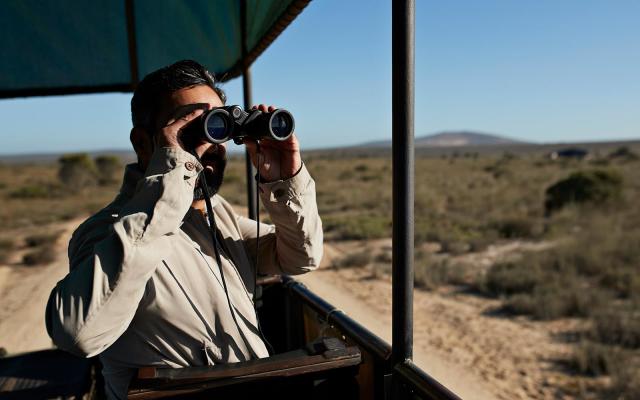
Constantly you will see curiosity take the better of you. If you have never before bothered to identify a bird, for example, you start wanting to do it, and the same goes with everything that you start to see. Your binoculars should be yours, and yours not to share; as asking to borrow somebody else’s means asking, readjusting the focus and – losing the moment, and after a few days you stop asking and you slowly diminish the experience and the excitement.
The Binoculars should be of good quality, have a reasonable field of view and a medium magnification. Never spend less than GB£ 200 / US$ 300. Magnification should be no less than 7 and not more than 10. ‘Field of View’ should be 30 to 42. Do not purchase binoculars with a zoom, as they are a gimmick.
‘Field of View’ is important mainly for allowing more light to enter the lenses and hence make it easier to use the binoculars in low light. It also gives you a bigger field so it’s easier to focus on what you are watching, especially if it is something small.
Small pocket binoculars will have a small field of view and hence the advantage of being able to slip them into your top pocket is immediately nullified when you get frustrated with using them later.
Although it is important to have light binoculars especially as they are hanging around your neck for many hours, it is also true that if they are too light they will not be of good hardy quality. Rubber protected and water proof binoculars are good, but a good pair tends to be more expensive.
Nikon and Minolta are good, but all guides and professional birders and hunters tend to like Zeiss or Leica. Swarovski are the Rolls Royce of binoculars. A good pair that will last a life time and something that maybe everybody should own will cost at least about GB£ 800 to 1,000. [Obviously get cheaper ones for the kids!]
My choice is: Leica or Zeiss 7 x 40 or 8 x 40 and 10 x 40, size is about 15 cm high and 13 cm wide.
Enjoy your Safari!
Frequently Asked Questions
Why should I bring binoculars on safari?
Binoculars can completely change your safari experience, especially in places like Serengeti National Park. Animals are often far away, resting in the shade, or partially hidden in tall grass, and binoculars help you see those details clearly. They allow you to spot birds, distant predators, or even subtle movements you might otherwise miss. Instead of just seeing “a shape,” you’ll notice expressions, patterns, and behavior. It makes the whole experience feel more immersive and personal.
What type of binoculars are best for safari?
For safari, a good pair of 8×42 or 10×42 binoculars is usually the best choice. The “8x” or “10x” refers to magnification, while “42” relates to the lens size, which affects brightness. In open areas like Ngorongoro Crater, these sizes give you a great balance between zoom and stability. Higher magnification can be harder to hold steady, especially in a moving vehicle. So it’s better to go for something reliable and easy to use rather than overly powerful.
Are expensive binoculars worth it?
You don’t need the most expensive binoculars to enjoy a safari, but quality does make a difference. Mid, range binoculars often provide clear images, good durability, and better performance in low light. In wildlife, rich areas like Tarangire National Park, you’ll appreciate sharper detail when watching animals at dawn or dusk. Cheaper binoculars may work, but they can be less comfortable and less clear. If you plan to use them often, investing a bit more is worth it.
Should I bring my own binoculars or use the guide’s?
Many safari guides do carry binoculars, but relying on them can mean missing out on spontaneous moments. Having your own pair lets you quickly focus on animals whenever you spot something interesting. In busy areas like Serengeti National Park, sharing may not always be practical. Personal binoculars also allow you to explore at your own pace without waiting. It’s a small item that adds a lot of independence to your experience.
What features should I look for in safari binoculars?
When choosing binoculars, look for features like good light transmission, a wide field of view, and comfortable grip. Waterproof and dustproof designs are also helpful, especially in dry and dusty parks like Tarangire National Park. Lightweight binoculars are easier to carry during long game drives. Adjustable eyecups are useful if you wear glasses. Overall, comfort and clarity matter more than having the highest specs.
Still have questions?
Our local safari experts are happy to help you plan the perfect African safari.





