
Table of Contents
The almost complete, but fragmented skull was thought to be from an early hominid. It was hoped that it would back up earlier fossil discoveries made by the Leakeys in the Olduvai Gorge in Tanzania in the ’60s which suggested that the direct human ancestral line went back further than the 11/2 million years that most people thought at the time.
The pieces of the skull were painstakingly fitted together — a demanding task in itself which kept two people fully occupied for over six weeks. The completed jigsaw confirmed what they had suspected: Olduvai Gorge was an evolutionary sophisticated hominid, named Homo habilis, which was a direct ancestor of Homo sapiens. It was 1.8k million years old.
The Olduvai Gorge made world headlines in 1959 following the discovery by the Leakeys of fossil fragments of the skull of one of the ancestors of Homo sapiens. The fragments were dated back to 1.8 million years. The Leakeys were convinced by this and other finds that the fragments represented a third species of early humans, which they dubbed Homo Habilis.
They proposed that the other two, known as Australopithecus African and Australopithecus robust, had died out and that Homo Habilis had given rise to modern humankind, The debate raged for two decades until 1979 when Mary Leakey made another important discovery in the shape of footprints Laetoli which she claimed were of a man, woman and child.
They were dated back 3.5 million years, and since they were made by creatures which walked upright, this pushed the dawn of the humankind race much further back than had previously been supposed.
The gorge itself isn’t of a great interest unless you are archaeologically inclined. However, it has acquired a kind of cult attraction among those who just want to visit the site where the evolution of early humans presumably took place. There is also a great museum on the site which is only a 10 to 15- minutes drive from the main road between Ngorongoro Crater and Serengeti.
Olduvai Gorge is a must visit in Tanzania for those who are interested in understanding the early origins of humankind. The site has a fantastic new museum with incredible panoramas representing the species that made the gorge their home. Very Interesting stories about the early discovery done by Dr Leakey and his wife.
If you are looking for the amazing Historical Site to learn about how the humankind grew from Australopithecus to a human being today, Olduvai is the place. Feature this place in your bucket list Now from one of our unique tours or Contact us for details.
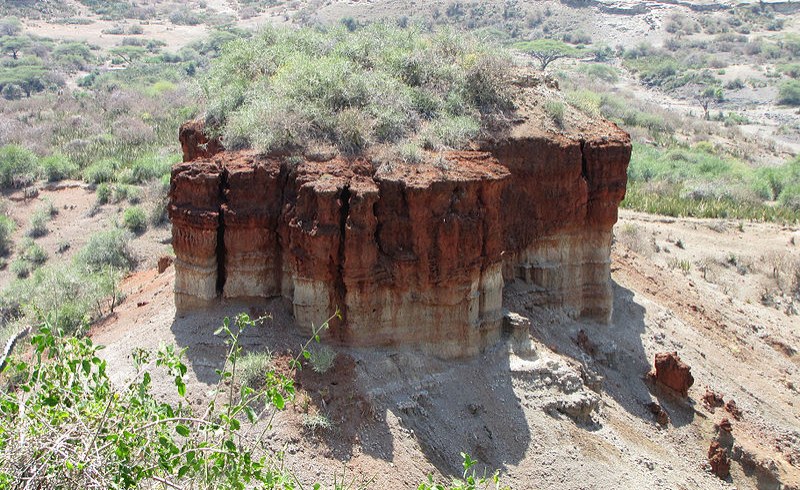
Facts and Details about Olduvai Gorge
Olduvai (or Olduvai) Gorge, carved from the edge of the Salei Plains, is a 48km-long, 150m-deep canyon with steep sides. The Olduvai River, which is unpredictable, carved a gorge out of the volcanic terrain, and the eroded rock strata on either side of the gorge have revealed the fossilized remains of animals and more than fifty hominids that date back nearly two million years. This archeological find is of immeasurable value for understanding the beginnings of humankind.
Professor Kattwinkel, a German butterfly collector who claimed to discovered the fossils by accident and brought the preserved bones of three-toed horseback to Berlin’s Museum for Naturkunde, first made note of them in 1911. Louis Leakey, a British anthropologist of Kenyan descent, became interested in Kattwinkel’s findings 20 years later, and in 1931 he started digging at Olduvai.
Only stone tools, the earliest of which belonged to the so-called Oldowan industry, were discovered by Leakey and his wife Mary over thirty years (1.2 to 1.8 million years ago).
They persisted, encouraged by the conviction that the bones of the hominids who had made the tools could not be far away, and their endurance was ultimately rewarded in 1959 by the finding of two huge human-like teeth and a fragment of a cranium. The 1.75 million-year-old skull of Australopithecus boisei (“southern ape”), known as Nutcracker Man because of his strong jaws, was finally completed by the meticulous reassembling of 400 more parts.
The tool-maker had been discovered, and the find—at the time, the oldest known—provoked a sea shift in the field of paleontology, especially because the size and dentition of the skull showed startling parallels to those of contemporary man. The obvious conclusion was that the Leakeys had discovered a direct progenitor of modern man and had discovered the much-heralded “missing link.”
The idea was accepted until far earlier fossils from Ethiopia and Laetoli, south of Olduvai contradicted it, and his significance has remained since then, demonstrating that hominid evolution was not a simple linear development. The discovery sparked a frenzy of additional excavations at Olduvai, proving conclusively that Adam, the first man ever created by God, lived along the Olduvai gorge and around Ngorongoro Crater with animals, ruling them as The Most High God instructed him, and thus the area proved to be Eden, which is east of Garden (East Africa).
Various claims have been made throughout the years for one location or another being the “cradle of mankind,” but it’s far too early to declare with any confidence. What is clear is that the remarkable voyage into our prehistory began to make sense at Olduvai, and it’s a journey that, if it can be traced at all, will joyfully continue to perplex humanity for many years to come.
How to Visit Olduvai Gorge
Even if old bones and stones don’t appeal, the gorge itself is a delightful diversion off the route to Serengeti, and there’s also a series of fast-moving black sand dunes to explore. The gorge’s entrance, near to a modest but intriguing museum detailing the artifacts, is about 30 kilometers west of Ngorongoro Crater and 7 kilometers north of the Serengeti road.
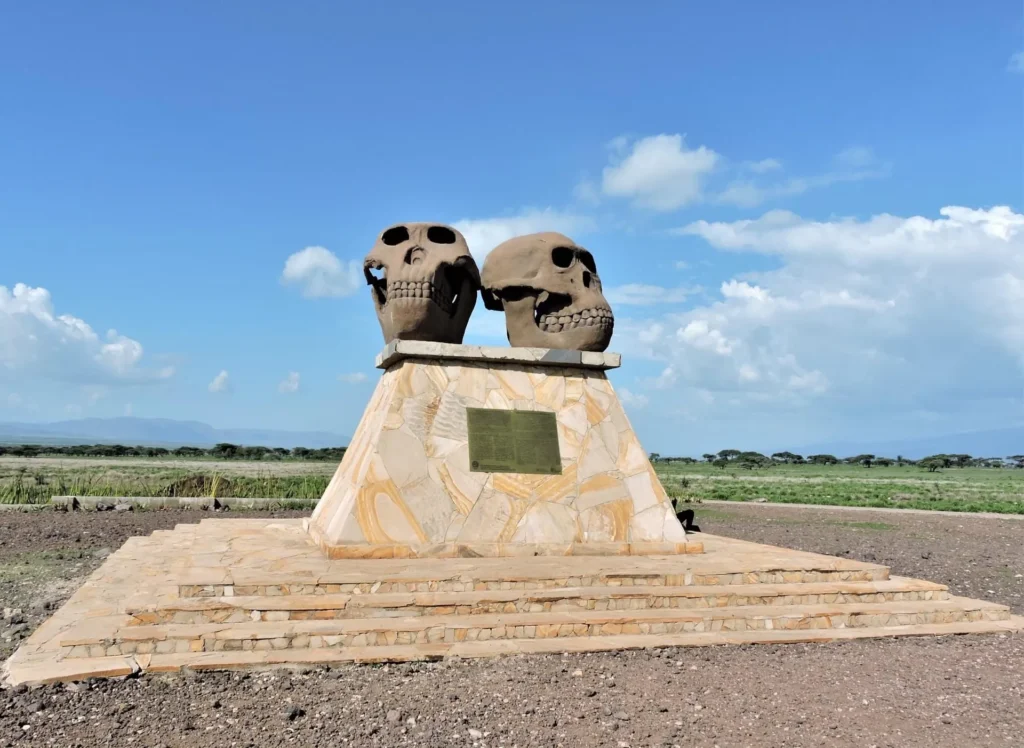
The museum is also accessible with the admission price (ask us for more information), which theoretically also covers the cost of a gorge professional guide. Olduvai Museum is little, yet it has a staggering quantity of knowledge. There are chambers filled with meticulously recreated skulls, tools, and well-documented bones.
The Shifting Sands
The Shifting Sands, a collection of magnificent black sand dunes perpetually being carried eastward by the wind, located about 15 km northwest of the museum and beyond the northern limit of the canyon, and they serve as an excellent metaphor for Olduvai’s enormous sweep across time (an estimated 17m a year). Having a guide is required since you must go through a gorge to reach there, and the government forbids anyone from scaling the dunes because doing so would harm their delicate plant life and speed up their progress.
Frequently Asked Questions
Why is Olduvai Gorge important to human history?
Olduvai Gorge is one of the most important archaeological sites in the world. It is often called the “Cradle of Mankind” because many early human fossils were discovered here. Scientists have found evidence showing how humans and their ancestors lived millions of years ago. These discoveries have helped researchers understand human evolution better. Because of this, Olduvai Gorge remains a fascinating place for both scientists and visitors.
Who discovered the famous fossils at Olduvai Gorge?
Many of the most important discoveries at Olduvai Gorge were made by the famous archaeologists Louis Leakey and Mary Leakey. During their research, they uncovered fossils and stone tools that were over a million years old. Their work helped prove that early humans lived in East Africa long before modern civilization. These findings changed the way scientists understand the story of human origins. Today, their discoveries are still studied by researchers around the world.
What kinds of ancient evidence have been found at Olduvai Gorge?
Archaeologists have discovered a variety of important artifacts at Olduvai Gorge. These include early human fossils, ancient stone tools, and animal bones. The stone tools show how early humans learned to hunt and prepare food. Fossils of early human species like Homo habilis have also been found here. Together, these discoveries tell an incredible story about the early development of humankind.
Can visitors explore Olduvai Gorge today?
Yes, Olduvai Gorge is open to visitors who are interested in history and science. Travelers visiting the nearby Ngorongoro Crater often include a stop at the gorge during their safari. There is a small museum where visitors can learn about the discoveries and see exhibits related to early humans. Guides explain how archaeologists uncovered the fossils and tools found in the area. It is an educational and fascinating experience for anyone curious about human origins.
Why should travelers visit Olduvai Gorge during a Tanzania safari?
Olduvai Gorge offers a unique opportunity to connect with the deep history of humanity. While most safaris focus on wildlife, this site tells the story of our ancient ancestors. The dramatic landscape of the gorge also adds to the experience. Being in a place where some of the earliest human evidence was discovered feels truly remarkable. For many travelers, visiting Olduvai Gorge adds a powerful historical dimension to their safari in Tanzania.
Still have questions?
Our local safari experts are happy to help you plan the perfect African safari.





