
Table of Contents
If you are planning to visit Nairobi city during the dry season, how about a game drive or nature walk in Nairobi National Park? There’s nowhere like it in the world, a unique wildlife safari destination right on the city’s doorstep. 117 sqkm of classic savannah attracts many migratory wild animals, tourists and local children.
Nairobi National Park was Kenya’s first National Park, established in 1946. It’s a unique ecosystem and the world’s only protected park with close city scapes. Boundaries are fenced, except for the park’s southern plains at Kitengela (the corridor for animals migrating from Athi-Kapiti plains). There is much for you to experience on a day’s safari here – many large herbivores, predators and bird species, as well as some fantastic activities. It’s best to spend a night in the park’s tented camp for the best game viewing opportunities.
Have you been to Nairobi National Park?
Write A Comment Below
A Difficult History
In the past, there has been much human-animal conflict due to the city’s rapid expansion and demand for land. In recent years, KWS and other organisations have been working hard to educate local communities about the critical role the park plays in protecting Kenya’s wildlife.
At the beginning of the 20th century, the small town of Nairobi grew significantly. Settlers carried guns to protect them and their livestock from lions, they complained of giraffes and zebras ruining their flowerbeds. Humans resented the animals sharing their space and the wildlife was driven out to the Athi plains at the south and west of Nairobi, which subsequently became part of the Southern Game Reserve. Hunting was unlawful and peaceful Maasai pastoralists were forced to leave the land, but everything else was allowed such as expanding farms, dumping rubbish, polluting Mbagathi River and even bombing by the Royal Air Force. The numbers of game fell alarmingly and the government agreed to set up Nairobi National Park in 1946.
Outstanding Landscapes, Easy Game Spotting and Other Highlights
A Surprising Mix of Habitats
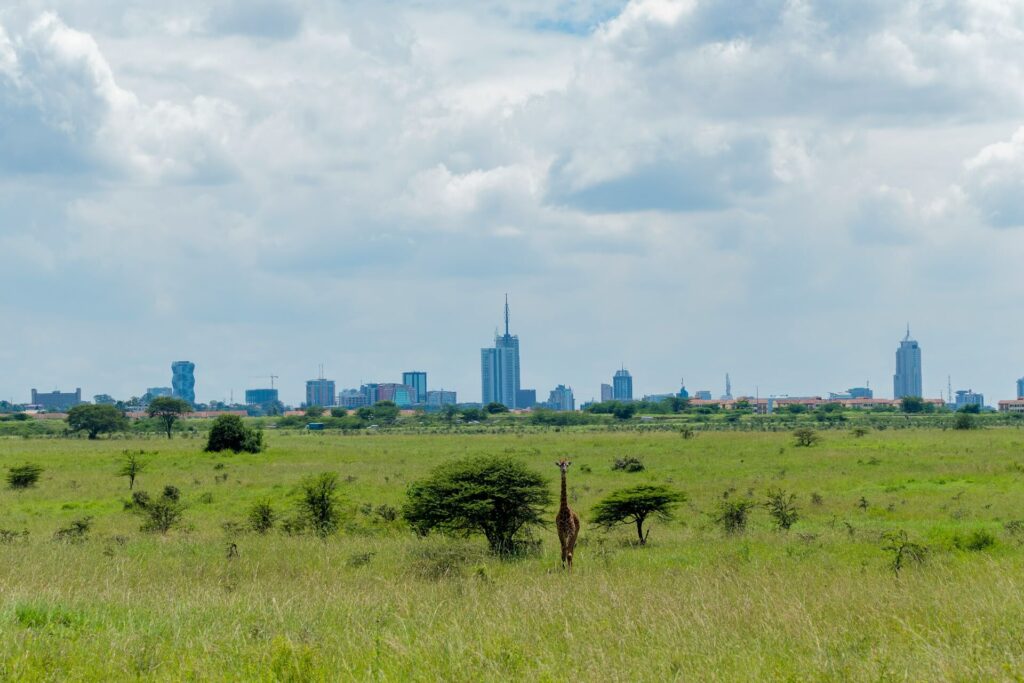
It’s a privilege to encounter such an outstanding and protected mix of habitats just outside a city. You’ll travel across wide rolling plains, rocky valleys, acacia bush, and riverine forest surrounding the Mbagathi River that feeds the park. When you look up and naturally expect to see the horizon, you’ll see the city scape instead – disconcerting, yet incredible at the same time!
Many species of migratory animals collect in the park during the dry season on the well-grazed savannah plains. You’ll see the local community also making good use of the park, with African school children visiting the animal orphanage and Wildlife Conservation Education Centre.
The Wildlife Isn’t Hard to Spot
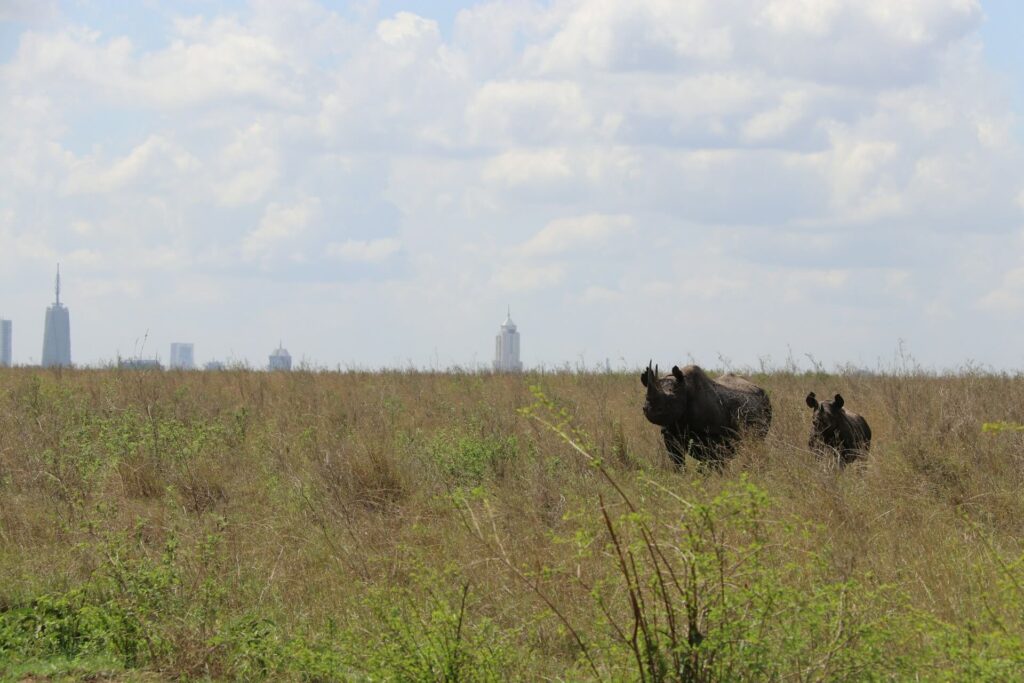
Expect to see a diversity of classic savannah wildlife in Nairobi National Park, especially during July and August when huge numbers of zebra and wildebeest collect at Mbagathi River. There are over 50 black rhinos and 11 white rhinos, all thriving under the park’s security. A visit to the animal orphanage is heart-melting, especially when the playful elephant and rhino calves take a bath. Other herbivores you are likely to encounter include buffalos, giraffes, elands, gazelles and hippos.
Spotting predators in the plains is not hard – look out for about 40 resident lions, a good amount of leopards, spotted hyena and a few cheetahs. It’s quite a thrill to see an elusive aardwolf in the savannah – an insectivorous mammal that looks like a mini, striped hyena. If bird watching is your thing, 400 species of bird have been recorded in Nairobi National Park so you will be spoilt for choice. The heaviest flying bird is here (Kori buzzard) and you might catch sight of a magnificent crowned eagle.
Activities
Game driving is best early in the morning and at the end of the day, when the park becomes more of a wilderness and an abundance of animal species roam peacefully. Visit the David Sheldrick animal orphanage (est 1963) during late morning to marvel at the elephant and black rhino claves having their daily mud bath. Another major attraction is the Nairobi Safari Walk, an on-foot experience of the park’s wild animals that also teaches you about the significant conservation projects taking place.
School children and local people are invited on these walks, when guides educate them about the importance of protecting Kenya’s wildlife. You can also visit the famous ivory burning monument as part of your safari experience. This monument was erected in memory of Kenya’s president who burned 12 tons of ivory in the park in 1989, an event that played a major role in accelerating Kenya’s conservation efforts.
Accommodation
The only place to stay inside the park is Nairobi Tented Camp, which offers well-organised day and night game drives and other activities. The Camp is situated on the edge of a forest, surrounded by nature. The 8 ensuite guest tents are pretty basic but the service is friendly. In your tent, there are comfortable beds, essential furniture, a toilet, basin and bucket shower.
If you want a hot shower, the water is heated over a fire and supplied when you are ready. Each tent is suitable for 2 people and there is a communal central tent where hearty meals are served. You can enjoy drinks and stories around the camp fire under a starlit sky before retiring to bed. Nairobi Tented Camp is ideal for a night or two, away from the bustling city. After all, it’s lovely to wake up to the sounds of the wilderness instead of traffic noise, before embarking on a game drive.
If you would prefer not to stay in camp, there is a wide choice of accommodation just outside the park and in the city. Probably the most unique is a hotel adjoined to Langata Giraffe Center. Here, you can be entertained by giraffes poking their heads through your window!
Best Time to Visit
Wild animals migrate into the park during the 2 dry seasons – January to February, and June to September. The thrilling wildebeest and zebra migrations are in July and August, an ideal time to visit.
How to Get There
Drive for just 7km along a tarmac road, the main road being Langata Raod. The park has several gates, so it’s easily accessible from Jomo Kenyatta Airport and Wilson airport.
Frequently Asked Questions
Which national park is located just 7 km from a major city?
One of the most unique wildlife parks in the world is Nairobi National Park, located only about 7 kilometers from the center of Nairobi in Kenya. This makes it one of the few national parks located so close to a large city. Visitors can see wild animals roaming freely with the city skyline in the background. The park offers a surprising escape into nature without traveling far from urban life. It’s a perfect destination for travelers who want to experience wildlife quickly and conveniently.
What animals can you see in Nairobi National Park?
Nairobi National Park is home to a wide variety of wildlife despite being near a city. Visitors may see lions, giraffes, buffalo, zebras, and many antelope species during game drives. The park is also known for its successful rhino conservation program, making it a good place to see both black and white rhinos. Bird lovers can enjoy spotting more than 400 bird species in the area. This incredible biodiversity makes the park a favorite for wildlife enthusiasts.
Why is Nairobi National Park considered unique?
What makes Nairobi National Park truly special is its location right next to Nairobi. Few places in the world allow visitors to see wild animals roaming against a backdrop of modern skyscrapers. The park covers a large open savannah with rivers, forests, and grasslands. This unique combination of urban and natural environments creates a fascinating contrast. It shows how wildlife and city life can exist close together.
What activities can visitors enjoy in the park?
Visitors to Nairobi National Park can enjoy several exciting activities. Game drives are the most popular way to explore the park and observe wildlife. Many travelers also visit nearby attractions like the David Sheldrick Wildlife Trust elephant orphanage. Birdwatching and photography are also very rewarding because of the park’s rich biodiversity. These experiences make the park an excellent short safari destination.
When is the best time to visit Nairobi National Park?
The best time to visit Nairobi National Park is during the dry seasons from June to October and January to March. During these months, animals are easier to spot as they gather around water sources. The weather is also pleasant for game drives and outdoor activities. Early morning visits are especially popular because wildlife is more active. This makes it a great stop for travelers beginning or ending their safari in Kenya.
Still have questions?
Our local safari experts are happy to help you plan the perfect African safari.





