
Table of Contents
If you want to make contact with your oldest relative, the chimpanzee, then Gombe National Park is your ideal one day walking safari. Gombe is Tanzania’s smallest National Park and home to around 100 wild chimpanzees. Track these incredible creatures through a strip of ancient tropical forest, criss-crossed by streams and waterfalls that run into Lake Tanganyika. You’ll encounter plenty more animals in Gombe, from pythons to baboons.
A Beautiful Place to Connect with Chimpanzees
A day’s tracking is enough to see the whole park and your guide will take you along the best trails, where you will almost certainly see chimpanzees very close-up. The scenery is stunningly beautiful, you’ll cross up to 13 streams with gushing waterfalls as you explore the rainforest – up hills, along ridges and down valleys. Picturesque mountains meet the shores of Lake Tanganyika, the world’s longest freshwater lake with white, sandy beaches and water so crystal-clear that you can easily see hundreds of thriving fish. When the sky is blue, you can look across the lake to the DR of Congo.
Have you been to Gombe National Park?
Write A Comment Below
Pioneering Research, Chimp behavior and Other Highlights
Dr Jane Goodall Made Gombe Famous
You might have heard of the British primatologist, Dr Jane Goodall, who played a major role in making Gombe the famous chimpanzee sanctuary that it is today. She arrived in Gombe in 1960 and founded a pioneering research program to study the behaviour of a group of wild chimpanzees she called the “Kasekela Community”. At that time, very little was known of chimpanzees in their natural habitat. This important research is still taking place in Gombe and is the longest running study of its kind in the world. It is a life-enriching experience when you encounter these habituated chimps as they go about their daily lives, and hard to put into words. This quote from Dr Jane Goodall will give you an idea of what you are about to experience:
“Chimpanzees have given me so much. The long hours spent with them in the forest have enriched my life beyond measure. What I have learned from them has shaped my understanding of human behavior, of our place in nature.” Dr Jane Goodall.
Chimp Behavior to Look Out for
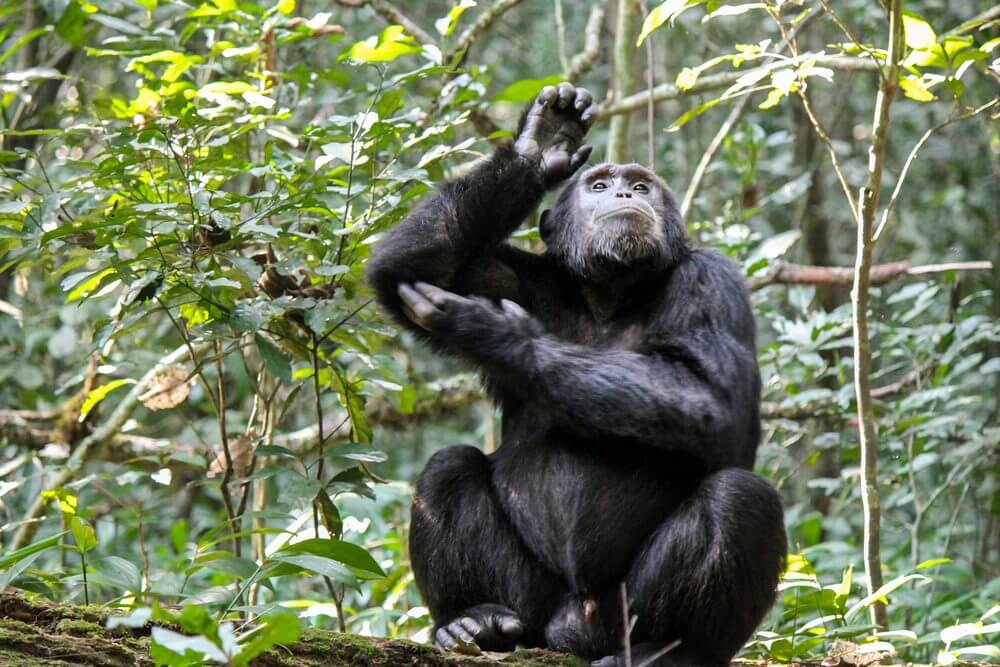
One of the most satisfying and fascinating experiences is to witness a day in the life of a wild, habituated chimpanzee. You’ll be astounded at how similar they are to us. When they make eye contact with you, you’ll see a flicker of understanding – what are they thinking? Your guide is trained to find the chimps and to explain their behavior to you. You’ll learn why they pant, hoot or scream; mothers and aunts will be carrying babies; some chimps will be aggressive or submissive, others will play and groom each other. They might be using tools to access food, some may be having…well, you know.
Other Wildlife
While you penetrate deep into the rainforest in search of the chimps, there is plenty of other wildlife to marvel at. You have a good chance of seeing several other primates, including blue monkeys, red-tailed monkeys, red colobus and Gombe’s “beachcomber” baboons that tend to venture really close to camp and are fun to watch. One highlight is witnessing the flight and iconic call of the fish eagle as it hovers, approaches its prey and grabs a fish with its talons. There are lots of bushpigs in the forest, camouflaged pythons, as well as 200 species of birds. Look out for crocodiles and hippos in Lake Tanganyika.
Activities
Of course the most popular thing to do in Gombe National Park is Chimpanzee tracking. You can hike in the forest and search for the many birds that frequent the area. As Lake Tanganyika is right on your doorstep, you can swim and snorkel in the lake, or take an ancient dhow out on the water to fish. If you are tired from tracking the chimps, why not relax and unwind on one of the lake’s soft, white beaches? There are two magnificent waterfalls that you can walk to in the area. Or take a cultural tour to nearby Ujiji where Dr. David Livingstone and Henry Stanley met in 1871, giving rise to the popular saying “Dr Livingstone, I presume”.
Accommodation
Accommodation at Gombe is limited but there is a luxury tented lodge right on the shores of Lake Tanganyika, plus a lovely guest house and a basic, but comfortable, self-catering hostel. You can also stay in a campsite on one of Lake Tanganyika beaches.
Best Time to Visit
Gombe can be visited at any time of the year, but July to October is best as it is the dry season. At this time of year, the chimps stay on the lower slopes which makes trekking that much easier and there are far fewer mosquitoes. The rainy season is from November to April when the temperatures are high, but the air is clear. The chimps will have moved away from the lake and higher up the slopes, but bird watching is particularly good.

How to Get There
From Kilimanjaro International Airport or Dar es Salaam, take an ongoing domestic flight to Kigoma. Gombe National Park is not an easy or cheap place to reach, due to its unspoilt environment and location. You can only access the park by boat from Kigoma town. A dhow trip takes less than an hour, or you can charter a private motorboat. It’s a fantastic boat trip!
Frequently Asked Questions
Why is Gombe National Park called a primate paradise?
Gombe National Park is famous for its population of wild chimpanzees, making it a paradise for primate lovers. Visitors can trek through the forest with trained guides to observe these intelligent animals in their natural habitat. The park also offers sightings of other primates, including red colobus monkeys and baboons. Its lush forested landscape along Lake Tanganyika provides a beautiful backdrop for wildlife watching. For anyone interested in primates, Gombe is one of the most rewarding places in the world.
Who made Gombe National Park famous?
The park became famous thanks to the pioneering research of Jane Goodall. She began studying chimpanzees here in the 1960s and documented their social behavior, tool use, and intelligence. Her work transformed the scientific understanding of primates and conservation. Today, visitors can learn about her discoveries and the ongoing efforts to protect chimpanzees. Jane Goodall’s legacy continues to inspire visitors from around the world.
What other wildlife can be seen in Gombe?
Besides chimpanzees, Gombe National Park hosts a variety of primates, birds, and small mammals. Visitors often see red colobus monkeys, baboons, vervet monkeys, and numerous colorful birds. The park’s forests and river valleys create rich habitats for smaller wildlife as well. Lake Tanganyika adds aquatic life and stunning scenery to the experience. While chimpanzees are the main attraction, the diversity of species makes the park a wildlife hotspot.
Can visitors track chimpanzees in Gombe?
Yes, chimpanzee tracking is the main activity in Gombe. Visitors walk through the forest with experienced guides who locate chimpanzee groups using their knowledge of the animals’ habits. Once found, travelers can quietly observe the chimps as they interact, groom, and play. These treks can be challenging but are extremely rewarding. It’s an intimate way to connect with nature and see primates up close in their natural environment.
When is the best time to visit Gombe National Park?
The best time to visit is during the dry season, usually from May to October. Trails are easier to walk, and chimpanzees are more active and visible. The wet season from November to April can make trekking more difficult due to muddy paths. However, the park remains lush and beautiful year, round. Planning a visit during the dry months ensures the most enjoyable and memorable primate experience.
Still have questions?
Our local safari experts are happy to help you plan the perfect African safari.





