
Table of Contents
Although it is one of Tanzania’s smallest parks, Arusha National Park is one of the most beautiful and spectacular. It is also one of the few that you are allowed to walk in (accompanied by a ranger). Yet few travellers appear to visit it, possibly because of their haste to press on to the more famous parks of Ngorongoro Crater, Serengeti and Mt. Kilimanjaro.
This is a profound mistake since it has all the features of those three parks, including a superb range of flora and fauna. The park’s main features are Ngurdoto Crater (often dubbed little Ngorongoro), the Momela Lakes and rugged Mt Meru (4556 metres), which overlooks the town of Arusha to the North. Because of the differing attitudes within the park (from 1500 metres to over 4500 metres) and the geological structure, there are several vegetation zones, which support appropriate animal species.
Mount Meru in Arusha
Mount Meru which is rivals Kilimanjaro is a mixture of lush forest and bare rock and has on its eastern side the spectacular Meru Crater, a sheer cliff face that rises over 1500 metres and is one of the tallest of its type in the world. Animal life is abundant, and although it is impossible to predict what you will see and exactly where you will see it, you can fairly certain of sighting zebras, waterbuck, reedbuck, klipspringer, hippopotamus, buffaloes, elephants, hyenas, mongoose, dik-dik, warthogs, baboons, vervet and colobus monkeys.
You might even catch sight of the occasional leopard, but there are no lions or rhinos. It is possible to see a good deal of the park in just one day – the Ngurdoto Crater, Momela Lakes and the lower slopes of Mt. Meru – assuming you are in a vehicle. But this won’t give you the chance to walk around, so it is much better to spend two days here, staying overnight at a campsite, contact us for more detail about the accommodation in Arusha National Park.
Mountain Meru History
It is estimated that Mt. Meru was formed 20 million years ago during earth movements associated with the formation of the Rift Valley. Sometime later, a subsidiary vent opened to the east of the volcano and Ngurdoto was born. As lava continued to spew out for thousands of years until a violent explosion blew it apart as a result of superheated gases being trapped beneath the earth’s crust.
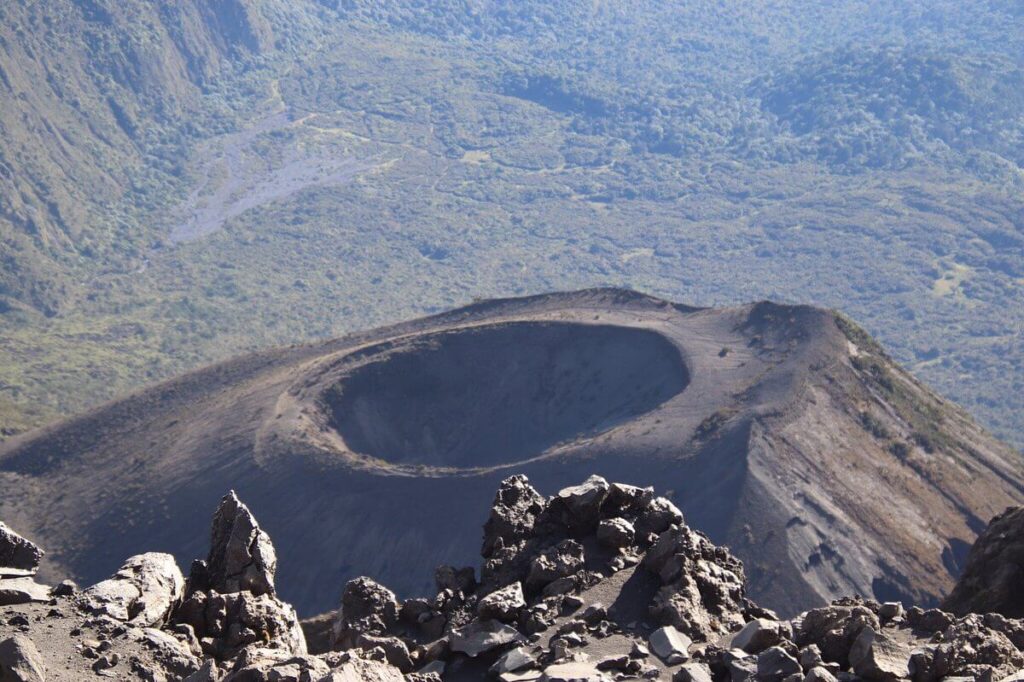
A repeated activity of this nature gradually increased the size of the crate until the molten rock withdrew to deeper levels, leaving the cone without support. It then collapsed to form the caldera which you see today. Although Ngurdoto is now extinct, Mt Meru is merely dormant, having last erupted only 100 years ago. The lava flow which occurred at this time can still be seen on the north-western side of the cone. The spectacular Meru Crater has formed 250,000 years ago as the result of a series explosions which blew away the entire eastern wall of the cone and showered the eastern side of the mountain with a mass of mud, rocks, lava and water. The Momela Lakes were formed out of depressions in the drying mud.
How is it Like to Climb Mount Meru
Most often, a safari companies is used for Mount Meru climbs. The climb begins at Momela Gate (1500m), where porters, rangers, and guides are available for rent. The journey is often completed in three days (two up, one down); those who choose a four-day climb will discover that the additional day is spent on the descent (stopping a second time at Miriakamba Hut) rather than the ascent, negating the benefit of spending the extra day for acclimatization. Although altitude sickness is not as common on Mount Meru as it is on Kilimanjaro, it should still be taken seriously if it occurs. Little Meru Peak, which is located on the crater rim but is 750m lower than Meru Summit, is a simpler objective than Meru Summit itself if you have minor altitude sickness.
Day One travels from Momela Gate to Miriakamba Hut in 4–5 hours (2514m). The longer and more scenery route follows a navigable trail to the south that begins by touching the large rocks Ngare Nanyuki (Red River); look for tawny eagles in the yellow-bark acacia trees here. The relatively steep and more direct route heads up due west; it is primarily used by trekkers when going down.
The path winds around Tululusia Hill (Sentinel Hill), which is home to a waterfall on the Tululusia River and a huge strangling fig tree with aerial roots that have naturally fashioned an arch. A kilometer further from the tree is Itikoni Clearing, a popular buffalo grazing area, a further kilometer is Jekukumia, where a little detour leads to the meeting of the Ngare Nanyuki and Jekukumia rivers. Both paths penetrate the rainforest, which is marked by the African olive tree and where bushbuck may be spotted, at around 2000 meters. Walking at Miriakamba Hut at night should be done with caution due to the presence of buffalo and elephant droppings.
Day two continues upward to Saddle Hut (3570m), which is beneath the summit’s horseshoe-shaped crater and is reachable in 2–3 hours. Although the symptoms of altitude sickness begin to manifest on this day, a quick diversion to Little Meru Peak (3820m) is doable (5–6 hours from Miriakamba Hut) if you have the time and energy.
Day three begins at 2 a.m. with a 4–5 hour climb to Meru Summit (4562.13 m, according to a sign at the top), which is followed by a relatively narrow ridge around the western rim of the crater. This allows time to reach the summit in time to see the dawn over Kilimanjaro.
You will be stopped at Saddle Hut for lunch on the way back down to the gate, after that, you will continue to Momela Gate, and by the time you get there will be in the late afternoon. As an alternative, you might take it easy and stay an additional night in Miriakamba Hut, which is about a 3 to 4 hours trek from the top.
What is the Secret of Arusha National Park
Arusha National Park receives relatively few visitors despite being close to Arusha Town. This is good news for visitors who do manage to visit because they can take in the park’s breathtaking volcanic scenery, expansive views (especially of its enormous neighbor, Kilimanjaro), hauntingly beautiful rainforest, and plenty of wildlife in relative solitude. The second-highest mountain in Tanzania, the volcanic Mount Meru (4566m), dominates the park.
From Arusha, Meru appears to be an almost perfect cone, but when viewed from the east, it displays the effects of the catastrophic volcanic incident that single-handedly destroyed the eastern side and summit of the mountain, which was once higher than Kilimanjaro, over a quarter of a million years ago. The eruptions threw boulders over 70 km to the east and triggered a devastating flood of water, rocks, mud, ash, and lava. Earth tremors still happen even though the volcano is currently categorized as dormant, and a number of tiny eruptions, the most recent of which was in 1910, were noted during the colonial era.
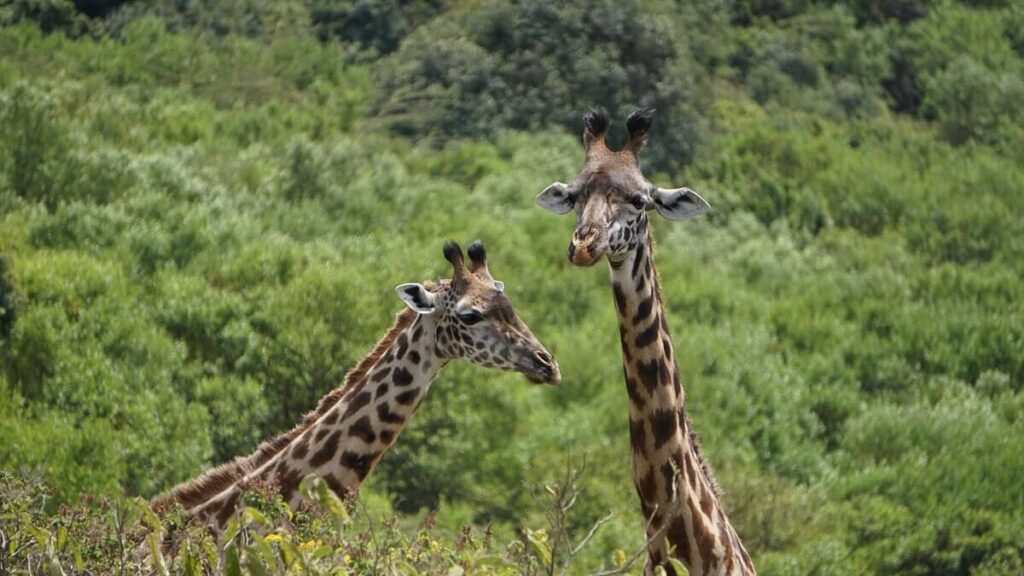
The 3.5km-wide Meru Crater on the mountain’s peak, the whole fragmented eastern slope, and the eastern foothills are all included by the national park and its bordering forest reserve. Ngurdoto Crater, a three-kilometer-wide unbroken caldera known as “Little Ngorongoro” because of its fauna, and the alkaline Momela Lakes, which are shallow and home to a variety of birds, including flamingos. Buffaloes, elephants, hippos, giraffes, warthogs, antelopes, zebras, black-and-white colobus monkeys, and blue monkeys are among the animals that you could observe in the wild. There are 575 different bird species, and butterfly lovers are in for a treat as well. Leopards and hyenas are there but rarely seen (there are no resident lions).

Ngurdoto Crater and Momela Lakes in Arusha National Park
This crater is surrounded by forest, while the actual crater floor is a swampy area. To the west of it lies Serengeti Ndogo (Little Serengeti), an extensive area of open grassland and the only place in the park where herds of Burchell’s zebra can be found.
The Momela Lakes and Ngurdoto Crater are the attractions of the park’s eastern region, which spans the wooded foothills of Mount Meru. Both are accessible via prearranged day excursions from Arusha. In the vicinity, if escorted by a park ranger, walking could be feasible. The volcanic material left behind when Mount Meru blew its top 250,000 years ago developed seven small, alkaline lakes that make up the Momela Lakes in the northeast of the park. The lakes’ opaque colors of emerald and turquoise are caused by several types of algae, which thrive in the alkalinity and make the area a perfect home for filter-feeding birds like flamingos.
This lake like many in a rift valley is shallow and alkaline and attracts a wide variety of water birds. The lake is fed largely from underground streams and, because of their different mineral content, each lake supports a different type of legal growth, which gives them each a different color. As a result, the birdlife varies quite distinctly from one stretch of water to another, even where they are separated by a strip of land only a few meters wide.
Pelicans, ducks, and a variety of migrating birds are among the other species, especially between May and October. In the woodlands around the lakes, sightings of black-and-white colobus monkeys are almost a given. You also could see blue monkeys, bushbucks, buffaloes, hippos, giraffes, and zebras. Contact us for additional information if you’re interested in canoeing on Little Momela Lake.
You can drive from Momela Lakes to Ngurdoto Crater, an unbroken, 3 km wide, 400 m depth volcanic caldera (eventually nicknamed “Little Ngorongoro”) created when two volcanic cones combined and ultimately collapsed; you can walk along the crater’s western and southern rims. Lokie Swamp and three additional lakes flank the driveable road south from Ngurdoto Crater. Similar to Ngorongoro, Ngurdoto is home to a wide range of animals, such as buffalo, elephants, baboons, and occasionally leopards. A number of locations on the south side of the rim provide good views of Kilimanjaro and may be used to see the crater’s inhabitants.
How and When to Visit Arusha National Park?
The park is 21 km from Arusha and is reached by turning off the main Arusha to Moshi road at the signpost for the national park Our professional guide and driver will take you to an excellent series of gravel roads and tracks within the park which he will take you to all the main features and viewing points.
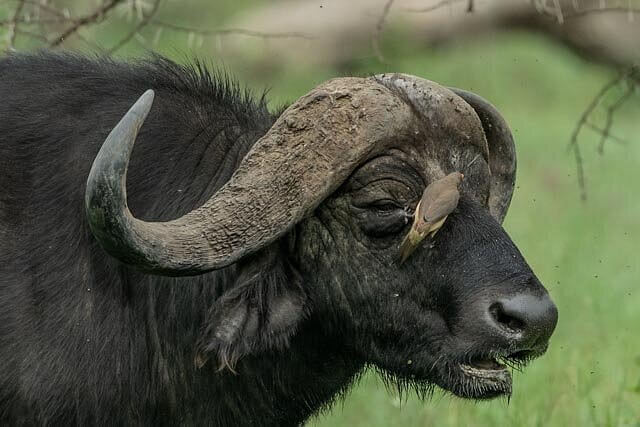
The park can be visited throughout the year with the rain season during October and November and again in March and April when you will need 4WD vehicles. When driving around the park, you must be accompanied by a guide, but if you intend to walk, an armed guide/ranger is compulsory because of the danger of buffaloes.
A guide/ranger is also compulsory if you intend to climb Mt. Meru and when you drive or walk around the Ngurdoto Crater rim, you are not allowed to walk down to the Crater floor. Safari ASAP guides contain knowledge and skills on how to take you around the park and experience the best wildlife view, birdlife, and plants to be found there. We will take care as a note on accommodation, transport, climbing Mt. Meru, and park entry fees.
What you intend to accomplish will determine the ideal time to visit. Although Mount Meru may be climbed all year long, it is advised to avoid it from March to May when it rains a lot since you risk becoming soaked, cold, and muddy. In September, when the mountain is at its coldest, then again from December through February, the skies are the clearest. It’s better to observe birds between. migratory seasons, from May and October.
Conclusion
Although the summit of Mount Meru is nearly a kilometer lower than that of Kilimanjaro, the trek may be just as gratifying due to the stunning surroundings and deep forest. Mount Meru is sometimes used as a warm-up climb before attempting Kilimanjaro. The vegetational zones of the mountain resemble those of Mount Kilimanjaro, however, there are no high-altitude glaciers or ice fields. Beginning at about 1800 meters, the evergreen forest is first chilly, wet, and dense before becoming thinner as you ascend. For little duiker antelopes and primates, particularly blue monkeys and black-and-white colobus monkeys, which are frequently spotted by climbers, the upper forest, which includes huge bamboo thickets (up to 12m tall), provides an ideal home.
At around 2900 meters, the forest departs and is replaced by flowering meadows where you could see buffalo, giraffes, or warthogs. After the meadows, there is a region of huge lobelia and groundsel, then, at 3400 meters above sea level, a barren alpine desert where the only noises other your own breathing are the wind and the calls of white-necked ravens.
Frequently Asked Questions
What makes Arusha National Park special?
Arusha National Park is unique because it combines mountains, lakes, and forests in a relatively small area. The park lies at the base of Mount Meru, offering stunning views and dramatic landscapes. Visitors can explore open savannahs, tropical forests, and volcanic craters all in one trip. The diversity of scenery makes it feel like multiple parks in one. It’s a great destination for travelers who want variety without long drives.
What wildlife can I see in Arusha National Park?
The park is home to a wide range of animals, from giraffes and zebras to buffalo and warthogs. Colobus monkeys are common in the forested areas, adding a playful touch to the wildlife experience. Birds are also abundant, making it a great spot for birdwatching. Although large predators like lions are rarer here, you may still spot leopards or hyenas. Arusha National Park offers excellent wildlife viewing in a peaceful setting.
Can visitors do walking safaris in Arusha National Park?
Yes, walking safaris are one of the park’s main attractions. Guided walks allow visitors to explore the forest, spot smaller wildlife, and learn about plants and animal tracks. Walking provides a more intimate experience compared to driving in a vehicle. It also gives travelers a chance to notice details they might miss on a game drive. For many, this is one of the most memorable ways to enjoy the park.
What scenic spots should I not miss in the park?
Key scenic spots include the Ngurdoto Crater, often called the “Little Ngorongoro,” and the beautiful Momella Lakes. The crater offers dramatic views and wildlife sightings, while the lakes are famous for flamingos and other waterbirds. Mount Meru provides a stunning backdrop for photos throughout the park. Each location offers its own unique natural beauty. Together, they make the park a photographer’s paradise.
Why is Arusha National Park a great choice for a short safari?
The park is conveniently close to the city of Arusha, making it perfect for a day trip. Travelers can experience wildlife, mountains, forests, and lakes without spending days on the road. It is less crowded than larger parks like Serengeti National Park, offering a peaceful experience. Activities are flexible, including game drives, walking safaris, and birdwatching. For visitors with limited time, it’s an ideal introduction to Tanzania’s natural wonders.
Still have questions?
Our local safari experts are happy to help you plan the perfect African safari.





